Coinche tips and tricks
Updated
Here is a set of coinche tips and tricks that genuinely make a difference. They are not rigid rules: judge by the deal. Each tip links to the article that explains it in depth.
Bidding tips
- Evaluate your hand before bidding. Count your winners and long suits, not just nominal points. This is coinche tip number one.
- Don't overvalue your hand. A made 90 beats a failed 110. When in doubt, aim lower.
- Choose trump by your shape. Five small trumps often beat three big ones: length makes the ruffs.
- Coinche when an opponent has clearly overbid, but not on reflex: a failed coinche lets them score 162 + contract × 2.
Lead and early-deal tips
- Think about your lead. Leading a trump, under an ace or into your partner's suit have very different effects: pick by the contract.
- Don't lead under an ace lightly. You risk handing it to a ruff. Sometimes right, often dangerous.
- Signal to your partner. Playing a high or low card isn't neutral: it's your only way to "talk" during the play.
Trump-management tips
- When you take, ask whether to draw trumps. Often yes, to protect your winners, but keep one to ruff if your hand calls for it.
- Count the trumps that fall. Once the opponents have none, your cards become untouchable.
- Don't waste your master cards. Play them when they score, not just to get rid of them.
Defence and end-of-deal tips
- On defence, play to set the contract. Count the points the opponents still need and focus on denying them.
- Keep the last trick. Those 10 points often decide a tight contract: hold a winner for the final trick.
- Never forget your belote. King + Queen of trumps = 20 points, but only if you announce it as you play the second card.
The best tip: practise
No list of tips replaces practice. The fastest way to lock these in is to test them in real situations and see the result. On Coincheur, play for free against tunable AIs, with a coach that flags your mistakes and targeted exercises.
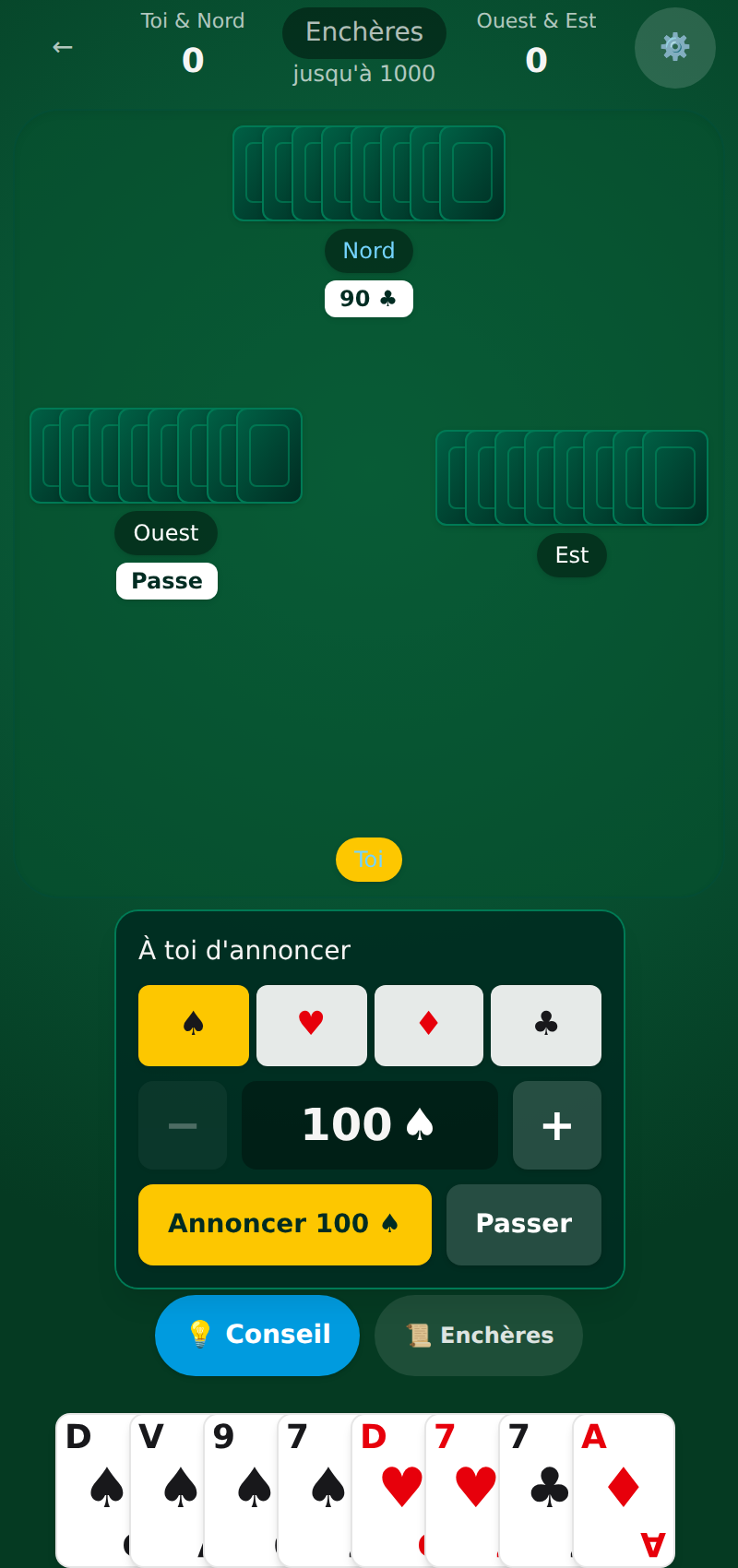 Want to practise? Play coinche online for free: tunable AIs and a coach are waiting for you on Coincheur.
See also
FAQ
What's the first coinche tip to remember?
Evaluate your hand well before bidding. Most lost deals come from an overbid contract: if you estimate correctly what your hand can do, you already avoid the majority of failures.
Should you always coinche when you think the opponent will fail?
No. Coinching doubles the contract's value: if you're wrong, the opponent scores 162 plus twice its contract. Coinche when they've clearly overbid, not on reflex or out of annoyance.
Are these tips absolute rules?
No, deliberately so. Coinche is a game of judgement: depending on the deal, the opposite tip may be right. Treat these as default reflexes to adapt to the situation.