When to double the opponents?
Updated
To coinche is to bet the opponents won't make their contract. The contract's value then counts double for whichever side wins the deal (162 + contract × 2).
What it changes
When you coinche, the opponents' contract goes to ×2. If it fails, your team scores 162 + contract × 2; if it makes, they do. It's a double-edged weapon: a winning shot can flip a match, a failed one can bury it.
Signs of a likely failure
- You hold master trumps the opponents will have to concede.
- You have sure side aces that will win tricks.
- Their bid looks high compared with what their team has shown.
When to refrain
Coinching on a hunch is dangerous. With no strong trump or master card, your shot rests mostly on hoping your partner has them. Mind the score too: when ahead, a cautious coinche protects your lead; when far behind, a bold one can be the right gamble. Several readings are defensible.
Example: should you coinche this 110 in spades?
The opponents ended the auction at 110 in spades. You hold the jack and 8 of spades, the ace of hearts, the ace and 10 of diamonds, plus three small cards. Think it through step by step:
- The defence's target: the declarer must take at least 110 of the 162 points. So your team only needs 53 to beat the contract (with no belote on either side, since it counts in the calculation).
- Your likely tricks: the jack of spades (20 points on its own) will win a trick eventually, and your two aces can win two more if they aren't ruffed.
- The risk: if the declarer is short in hearts or diamonds, they will ruff your aces. Your 8 of spades guards the jack a little, not much.
Three tricks holding 20 + 11 + 11 points, plus whatever falls on them: the 53 points are within reach. The coinche is defensible. Without the jack of spades, with just your two aces, the same decision becomes far more speculative.
What a coinche costs, both ways
On Coincheur, the multiplier applies to the contract value, not to the deal's 162 points. For the same 110:
| Situation | Who scores | Calculation |
|---|---|---|
| Not coinched, failed | Your defence | 162 + 110 = 272 |
| Coinched, failed | Your defence | 162 + 220 = 382 |
| Coinched, made | The declarer | 162 + 220 = 382 |
So the coinche earns you 110 more points than a plain failure when you're right, but hands the opponents 382 points when you're wrong, instead of their card points + 110. Some tables also double the 162: Coincheur's scoring is the one above. For the full calculation, see how to calculate a contract's score.
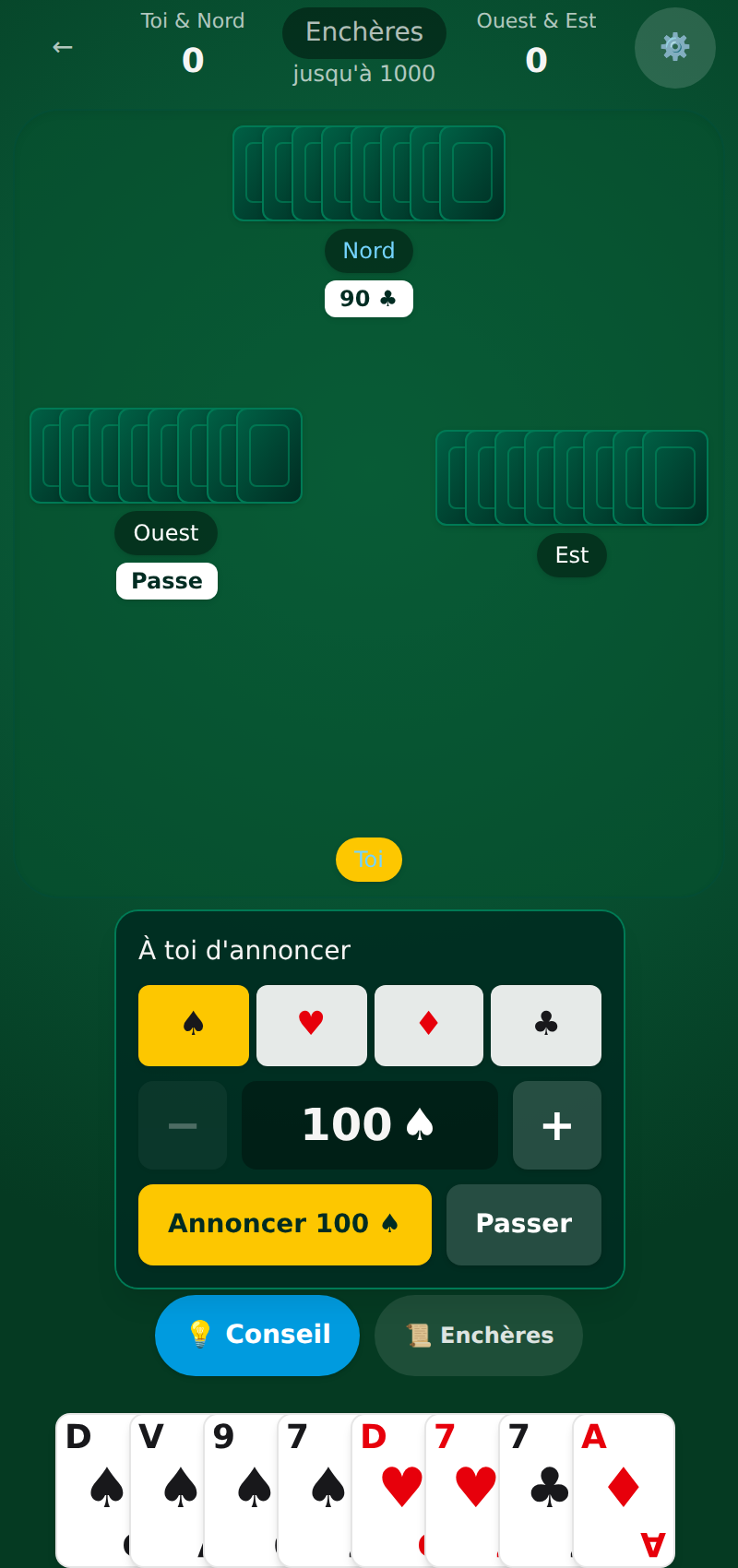 Want to practise? Play coinche online for free: tunable AIs and a coach are waiting for you on Coincheur.
See also
FAQ
How much does coinching multiply the points?
The contract's value counts double (×2): the side that wins the deal scores 162 + contract × 2. If the declarer then surcoinches, it rises to ×4 (162 + contract × 4).
Should you coinche as soon as you hold the trump jack?
No. The trump jack helps, but a coinche is decided on your whole hand, the opponents' bid and the score. A single master trump isn't always enough.
What is the most common mistake when coinching?
Counting your aces as sure tricks. If the declarer or their partner is short in the suit, your ace gets ruffed and scores nothing. Master trumps in the opponents' suit are often firmer ground than side aces.
How many points does the defence need to beat a contract?
It must stop the declarer from reaching the contract. Against 110, the defence needs at least 53 of the 162 points; against 80, it needs 81, because the declarer must also score strictly more than the defence. A belote shifts these thresholds by 20 points.