How to get good at and improve at coinche
Updated
Getting good at coinche is no gift: it's a method. Play often, review your deals, count the cards and fix your recurring mistakes: here is how to improve step by step.
Lay the foundations first
You can't build on shaky ground. Before aiming for subtle play, make sure you own the basics: the rules, card values (in trumps the Jack is worth 20 and the 9 is worth 14; off-trump the Ace is worth 11) and counting up to a deal's 162 points. As long as counting a deal takes effort, your brain has no room left for strategy.
If you are truly starting out, begin with how to play and with cutting out common mistakes: those are the beginner links below.
Play a lot, but play on purpose
Volume matters, but deliberate volume matters ten times more. Instead of playing on autopilot, set one goal per session: "this time I track the trumps that fall" or "I'll test the trump lead." Every game becomes a small lab.
- Practise regularly, in short focused sessions.
- Do drills on one specific point (bidding, defence, counting).
- Play against the computer to rehearse without pressure and test ideas.
Review your games
The real accelerator is review. After a lost deal, ask: was the bid right? The lead? Did I draw trumps too early? You learn more from one dissected deal than from ten forgotten ones.
Spot your recurring mistakes: many players keep losing on the same pattern (overvaluing the hand, forgetting the last trick, wasting a winner). Fixing just one of these reflexes pays off for good.
Learn to count the cards
Counting isn't memorising all 32 cards at once, it's tracking the essentials: how many trumps have fallen, which aces have gone, who discarded what. The moment you know the opponents are out of trumps, your winners become untouchable and your play changes completely.
Start small: count only trumps for a few games, then add the aces. It's a trainable skill, like the rest.
A simple improvement routine
| Level | What to work on |
|---|---|
| Beginner | Rules, card values, counting, first games |
| Intermediate | Hand evaluation, the lead, drawing/keeping trumps |
| Advanced | Signalling, card counting, coinching at the right moment |
You can follow this whole path for free on Coincheur: games against tunable AIs, a coach and exercises to drill the exact point you're working on.
For the drills part of this routine, see how to practise coinche with drills. And to string games together, free contract belote online on Coincheur is all you need.
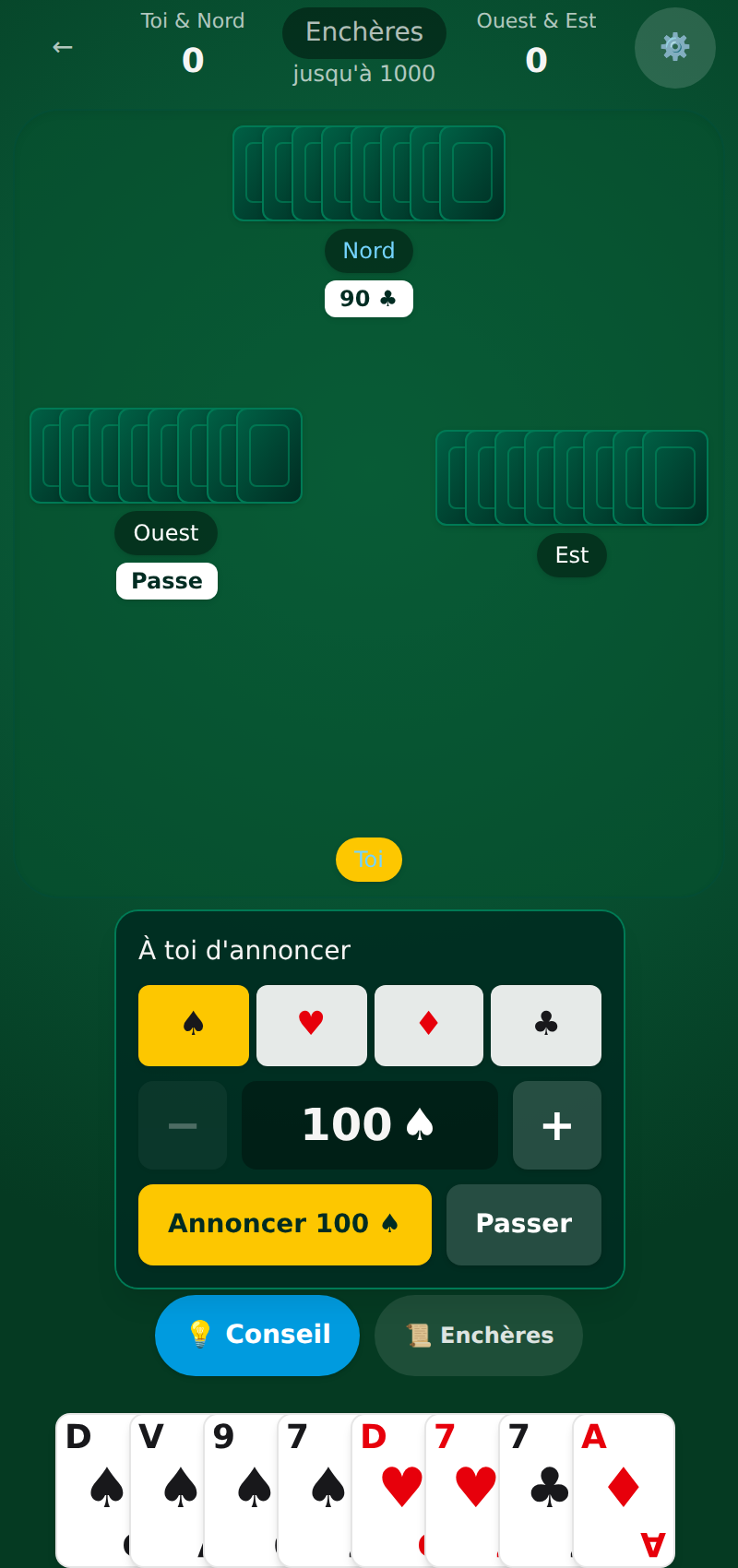 Want to practise? Play coinche online for free: tunable AIs and a coach are waiting for you on Coincheur.
See also
FAQ
How long does it take to get good at coinche?
It depends on your method more than your hours. By playing regularly, reviewing your deals and fixing recurring mistakes, you improve noticeably within a few weeks. Playing without ever questioning your choices plateaus fast.
Do you really need to count cards to play well?
Not everything at once. Start by counting the trumps that fall, then the aces. Just knowing when the opponents are out of trumps already transforms your play. It's a skill you build up gradually.
Does playing against the computer help you improve?
Yes, a lot. You play without pressure, can test ideas and repeat a specific situation as often as needed. With a coach and exercises, it's one of the most effective ways to practise.