Talking to your partner: the signals
Updated
In coinche, talking is forbidden during play: you communicate with your partner only through the cards you play. Here are the basics.
The call: asking for a suit
When you can't win the trick, the card you discard speaks. Playing a high card (above the seven) in a suit usually signals strength there and "calls" your partner to lead it back. A small card says the opposite: stay away.
The meaningful discard
When you're out of the led suit and not ruffing, choose your discard on purpose. Discarding a suit generally shows you have nothing to keep there, so your strength lies elsewhere. Your partner reads where your points are.
Stay careful
- Signals are table conventions: agree on them beforehand.
- Opponents read your cards too: a signal informs everyone.
- The contract comes before the signal: don't waste a trick just to "talk."
Example: a call on defence
An opponent took 90 in spades. Your partner leads the A♣, declarer follows with the 7♣, and it's your turn. You have no clubs and hold, among others, A♥ 10♥ 8♥ and 7♦ 8♦.
- Your partner is winning the trick: you're not forced to ruff, you may discard any card.
- The 10♥ is tempting (10 more points), but the last opponent plays after you and can still ruff your partner's ace.
- The 8♥ calls for hearts at no risk: with the direct call convention, it says "lead hearts back, I'm strong there." The 7♦ would rather say "not diamonds."
If your partner leads hearts later, your ace wins and your ten becomes the master.
Reading your partner's cards
A common mistake is over-reading a forced card. If your partner follows suit, ruffs or overtakes because the rules require it, the card says nothing: they had no choice. Only freely chosen cards (a lead, a discard when discarding is allowed) carry a message. Other guidelines:
- Cross-check the signal with the bidding: a suit that was bid and then called is a clear message.
- A call doesn't need repeating: once understood, your partner keeps their useful cards.
- When in doubt, counting points comes before reading an ambiguous signal.
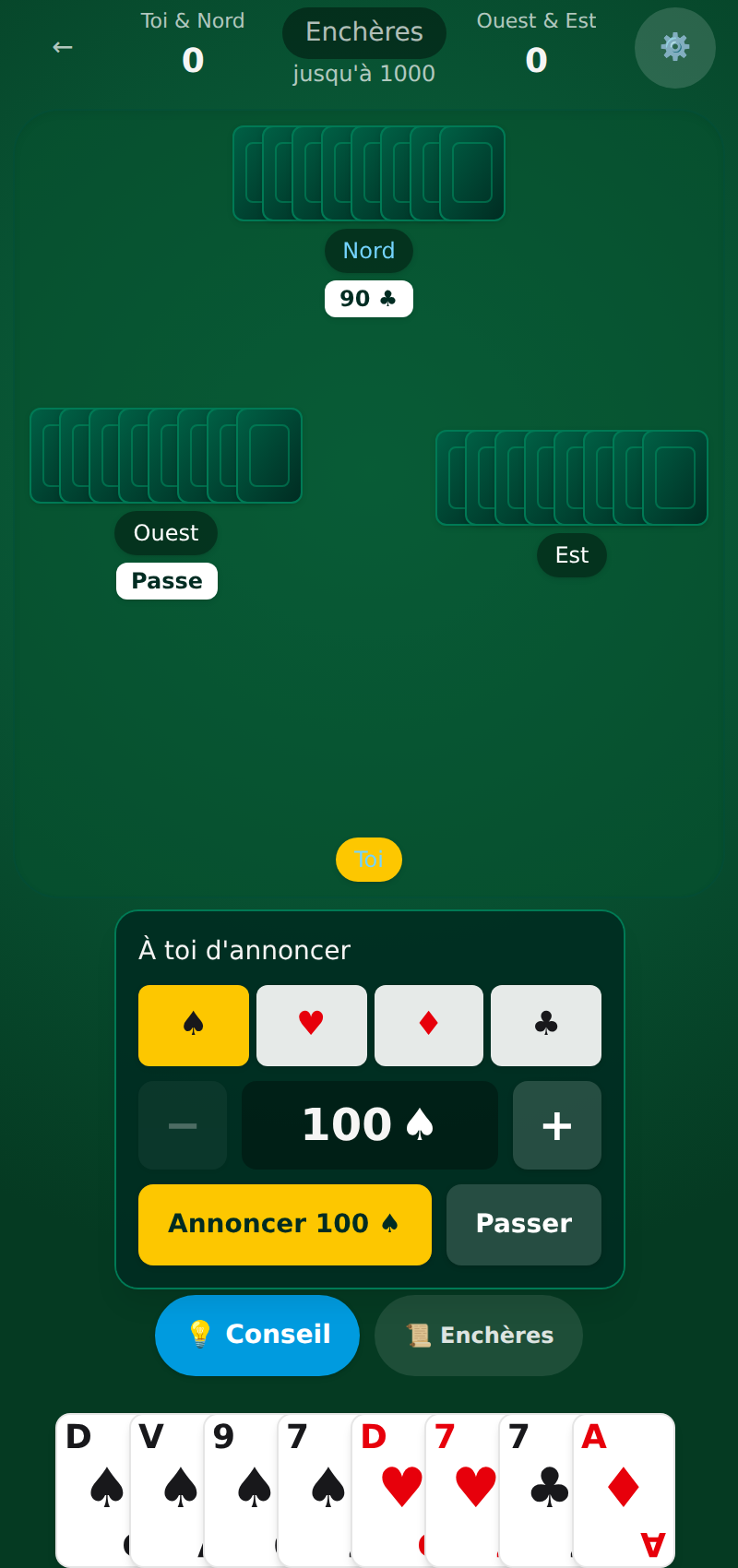 Want to practise? Play coinche online for free: tunable AIs and a coach are waiting for you on Coincheur.
See also
FAQ
How do you call a suit to your partner?
By playing a high card (above the seven) in the suit, you signal strength there and invite your partner to lead it back. A small card signals the opposite.
Does the signal also inform the opponents?
Yes. Everyone sees the cards, so a signal informs all four players. Use it when the gain for your side outweighs the risk.
Is a card played by obligation a signal?
No. When your partner must follow, ruff or overtake and has only one option, the card carries no message. Only the cards they choose freely, such as the lead or a discard, can be read as signals.
What's the difference between a direct and an indirect call?
With a direct call, you show the suit you want led back. With an indirect call, your discard points to another suit according to a rule agreed in advance. Both exist: what matters is using the same one as your partner.