Defending against declarer: forcing it down
Updated
When an opponent takes the contract, your goal shifts: you no longer try to make it, you try to stop them reaching their contract, ideally to set it.
Count for the set
Declarer must make their contract out of 162 points. Your defence wins if it keeps them below their bid. Track how many points they still need: every defensive trick, every ten you grab counts.
Cash your masters fast
Against a declarer who'll draw trumps, take your aces and tens while you can. Waiting risks seeing them ruffed. Leading your side ace is often the right first defensive move.
Play as a team
- Overtake declarer's card, not your partner's.
- Drop your points (ten, ace) under the trick when your partner is master.
- Signal your strong suit so they lead toward you.
Example: declarer took 100 in hearts
Declarer needs at least 100 of the 162 points. If your side scores 63 or more, they have at most 99: they go down. That's your target in numbers.
Your defensive hand: A♠ 10♠ 7♠, A♦ K♦, 8♥, Q♣ and 7♣. Step by step:
- Your A♠, 10♠ and A♦ are worth 11 + 10 + 11 = 32 points on their own, before counting the cards dropped under them. That's halfway there.
- Declarer will probably draw trumps quickly. Each trump round brings them closer to the moment they can ruff your aces. So cash early, starting with the A♠.
- Your 8♥ is worthless against their trumps: don't count on it for a trick.
- The 10♠ is the master once the ace is gone, but on the second round of spades a ruff becomes possible. Check who followed on the first round before playing it.
Common defensive mistakes
- Waiting: an ace kept "for later" often ends up ruffed.
- Overtaking your partner when they already win the trick: you waste a strong card.
- Forcing declarer to ruff without thinking: if they're short in trumps, making them ruff shortens them and can break them. If they have plenty, you're handing them an easy trick.
- Forgetting the last trick: 10 points can be the difference between 62 and 72.
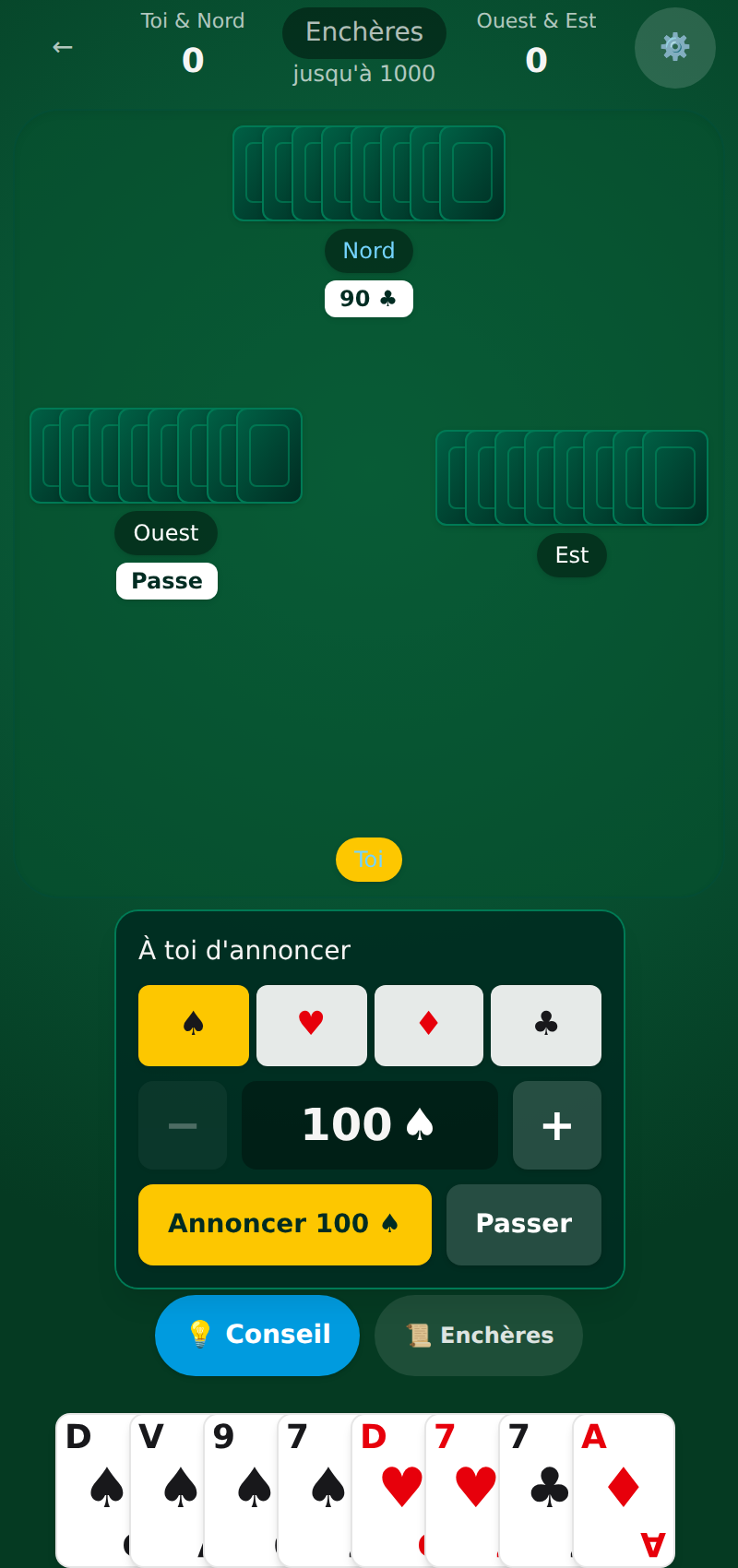 Want to practise? Play coinche online for free: tunable AIs and a coach are waiting for you on Coincheur.
See also
FAQ
How do you set declarer in coinche?
By keeping them below their contract: cash your masters before trumps are drawn, grab points from them and coordinate with your partner.
Should you put points on your partner's tricks?
Yes, when your partner already wins the trick, slipping a ten or ace under it raises your defensive total at no risk.
How many points do you need to set a 100 contract?
Declarer needs at least 100 of the 162 points. If your side scores 63 or more, they're left with at most 99 and go down. A belote can change this calculation depending on your table's rules.