Coinche strategy: the complete guide
Updated
Coinche strategy plays out on two fronts: the auction, where you set the goal, and the card play, where you deliver it. This guide links the two and points you to the detailed article for each topic.
The two halves of coinche strategy
A deal is won first in the auction, then at the table. Many players polish one and neglect the other: an overbid contract fails even when well played, and a sound contract is lost with a careless lead. Good coinche strategy means thinking through the whole deal from the moment you bid: "If I take this at 100 in spades, how will I make my tricks?"
Keep the scoreboard in mind: a deal is worth 162 points (152 + 10 for the last trick), belote (King + Queen of trumps) adds 20, and a bid capot is a 250 contract (502 points when made). A coinche doubles the stakes (×2), a surcoinche quadruples them (×4). Your whole plan revolves around these numbers.
Bidding well: the foundation
Before you bid, evaluate your hand honestly: master trumps, side aces, long suits. The usual opening sits around 80, but nothing is dogmatic: with a partner who has already spoken you climb faster; alone against silence you stay cautious.
- When to open and at what level to start.
- Choosing the trump suit based on shape, not just card count.
- Supporting or raising over your partner without overbidding them.
- Coinching when an opponent clearly overbid, passing when doubt prevails.
Each of these has its own article, but start with hand evaluation, the skill that pays off fastest.
Playing the cards: turning a bid into tricks
Once the contract is set, strategy shifts. The declarer often draws trumps to secure winners, but not always: keeping a trump to ruff can score more. The defence aims to set the contract, grab points and keep the last trick.
| If you are declarer | If you defend |
|---|---|
| Count your sure tricks before playing | Count the opponent points left to deny |
| Draw or keep trumps to fit the plan | Ruff, cash points, don't waste your winners |
| Keep a card for the last-trick bonus | Steal the last trick when the contract is tight |
Lead, signalling and reading the table
The opening lead sets the tone: leading a trump, under an ace, or into your partner's suit changes the whole hand. Signalling (playing low or high to inform your partner) turns two separate hands into a real team. And counting the trumps that have fallen tells you when your winners become untouchable.
These are not rigid recipes: a good player reads the table, notes who ruffed what, and adapts. That is exactly what you build by playing and reviewing your deals.
Putting strategy into practice
Reading alone won't do it: you need to play many deals and look at what worked. On Coincheur you play coinche for free against tunable AIs, with a coach and exercises to test your bidding and card play. Treat this guide as a map: each link below opens a specific topic to dig into.
The fastest way to apply these ideas is to practise coinche with drills, then test them in a game of free contract belote online.
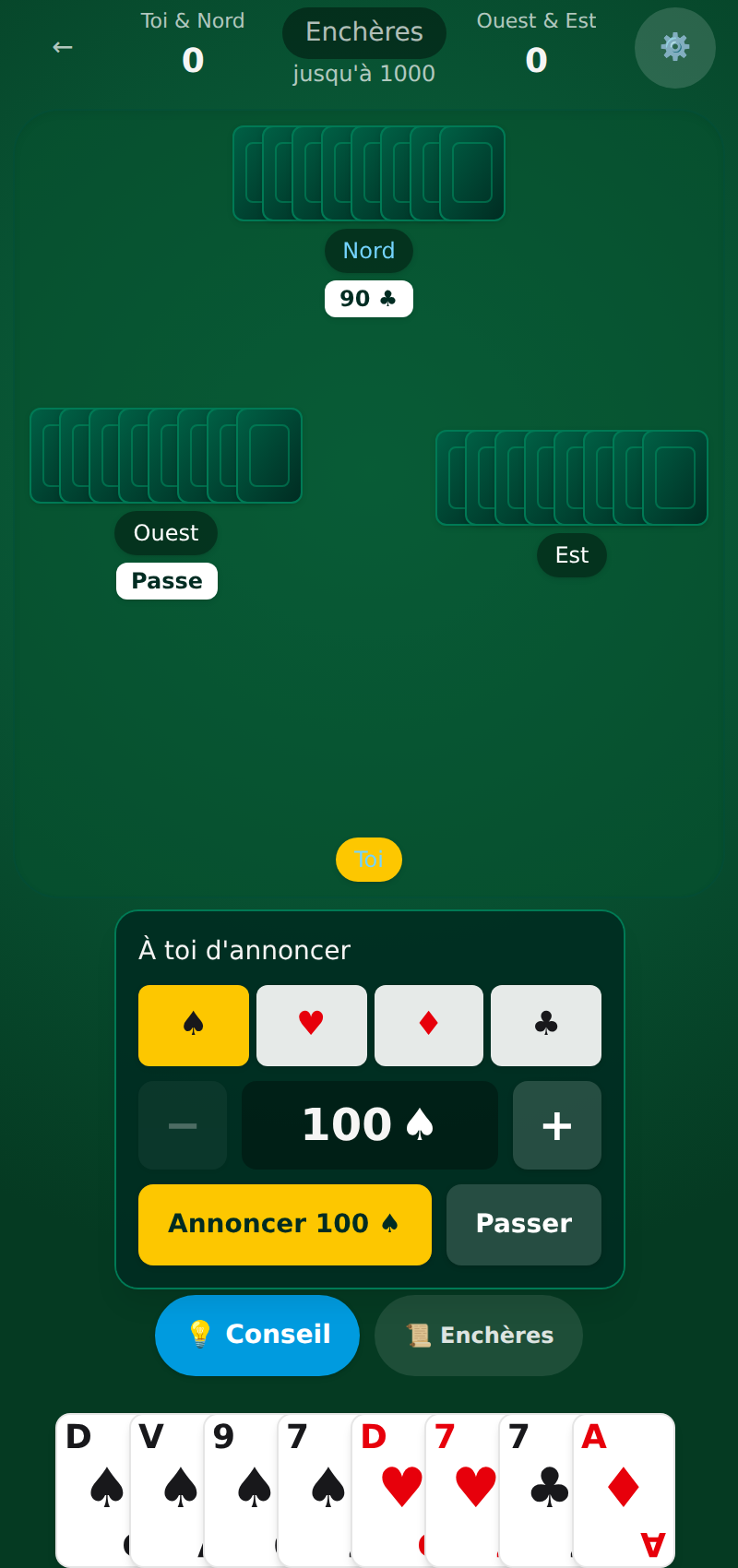 Want to practise? Play coinche online for free: tunable AIs and a coach are waiting for you on Coincheur.
See also
FAQ
Where should I start to improve my coinche strategy?
With hand evaluation in the auction. Estimating correctly what your hand can do avoids overbid contracts that fail, and it is the skill that gains the most points fastest.
Should the declarer always draw trumps?
No. Drawing trumps secures your winners, but keeping a trump to ruff an opponent's suit sometimes scores more. It depends on your hand and the contract: it is a choice, not an automatic rule.
Does strategy matter more in the bidding or the card play?
The two are inseparable. A good bid played badly fails, and perfect play on an overbid contract still loses. Real strategy is thinking through the entire deal from the bid.