Evaluating your hand before bidding
Updated
Before any bid, take time to read your hand. Good judgment beats a point chart applied blindly.
The three basic questions
- My trumps: how many, and which are masters (jack, nine, ace)?
- My sides: do I have aces or winners outside trumps?
- My shape: am I long somewhere, short elsewhere (so I can ruff)?
Master trumps and length
The trump jack is worth 20 and the nine 14: these two cards are decisive. A long trump suit (5 cards or more) gives you control even without every honour. Conversely, three small trumps with no jack or nine is fragile.
Think in tricks, not just points
Counting your hand's points helps, but the real question is the tricks you can win. A master ace on the side is a sure trick; a long suit may yield several late in the deal. Assess what you control, then set your bid remembering your partner will add their share.
Example: J-9-A of hearts and the ace of spades
You hold the jack, 9 and ace of hearts, the ace and 10 of spades, the king of clubs, and the 8 and 7 of diamonds. Run through the three questions in order:
- Trumps (hearts): three cards, and they're the three strongest. Playing them pulls a good share of the opponents' trumps. Five are still out (10, king, queen, 8, 7): you don't control them all, but you're in charge of the suit.
- Side suits: the ace of spades is a likely trick, and the 10 of spades can become one once the ace has gone. The lone king of clubs is fragile.
- Shape: two small diamonds, a single club. After one round of clubs you can ruff, as long as you keep a trump back.
In points: 20 + 14 + 11 = 45 in hearts, 11 + 10 = 21 in spades, 4 in clubs, so 70. In tricks: three master trumps, one or two tricks in spades. This hand clearly justifies opening in hearts. 80 is a comfortable start, 90 is defensible to describe an already solid hand. Your partner's support will tell you whether to go higher.
Quick guidelines (not a fixed chart)
| Hand profile | Possible reading |
|---|---|
| Trump jack or 9 + at least two more trumps + a side ace | Natural opening, often at 80 or 90. |
| Long trumps (5 or more) without the jack | Playable if the side suits help, riskier if your partner brings nothing. |
| Several aces, short trumps | More of a supporting or defensive hand, or No Trump if your table plays it. |
| No master trump and no ace | Passing is usually the wisest. |
These rows are starting points. The score, your seat at the table and what your partner has already bid can all tip the decision. For card values in detail, see counting your hand's points.
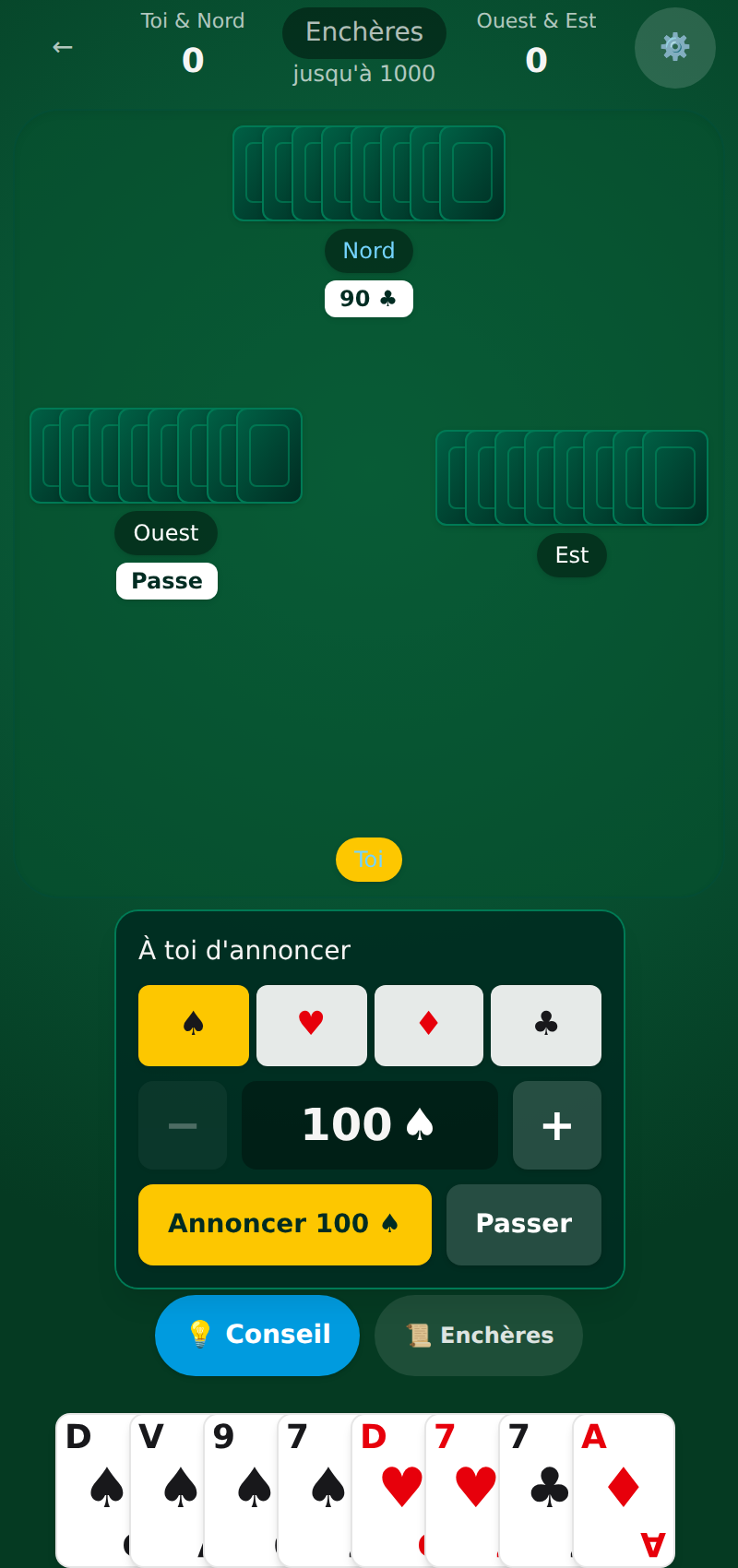 Want to practise? Play coinche online for free: tunable AIs and a coach are waiting for you on Coincheur.
See also
FAQ
Should you count points or tricks?
Both complement each other. Points give a first impression, but reasoning in winnable tricks is often more reliable when deciding a bid.
Can a hand without the trump jack still bid?
Yes, if it's long in trumps or rich in side aces. The missing jack makes the contract riskier without forbidding it. It depends on the rest of the hand.
How many trumps do you need to take?
There's no absolute minimum. Three trumps including the jack or the 9 are often a comfortable base, but four or five middling trumps can also hold up if your hand has side aces or a ruff.