Leading under the ace: avoid it or dare it?
Updated
Leading under the ace means playing a small card in a suit where you hold the ace, without playing the ace. Often risky, sometimes clever.
Why it's risky
Leading a small card under your ace lets an opponent win with a weaker card (king, queen) you would have beaten. Worse, your ace may then get ruffed if the suit comes back. Hence the saying "never under an ace."
When it's still defensible
The saying isn't absolute. Under-leading can be good when:
- Your partner bid the suit: you play toward their strength.
- You want to keep your ace as a safe entry for later.
- You want to force an opponent ruff to read the distribution.
The alternative: cash the ace
When in doubt, playing the ace banks the trick right away and avoids losing it. It's the safe lead when the ace is bare or barely supported. Under-leading is a thought-out play, not a reflex.
Example: what leading under the ace costs
An opponent took 100 in clubs. You hold A♦ 9♦ 7♦ and lead the 7♦. The next player plays the jack, your partner the 8, and declarer wins with the king. They collect 0 + 2 + 0 + 4 = 6 points and take the lead.
Had you played the ace and the others played the same cards, that trick would have brought you 11 + 2 + 0 + 4 = 17 points. And that's not all: declarer may now be out of diamonds. On the next round of diamonds, your ace risks being ruffed, and its 11 points would go to the opponents.
A case where it makes sense: your partner's suit
During the bidding, your partner bid diamonds before an opponent took the contract in clubs. You hold A♦ 8♦. If you lead the 8♦ and your partner has the 10♦, their card is the master of the suit, since you hold the only higher card: the ace. They win the trick, and your ace stays as an entry for later. It's a bet on their hand: if they don't have the ten, an opponent may win cheaply. The play makes sense when your partner's bid makes the bet reasonable, not as a reflex.
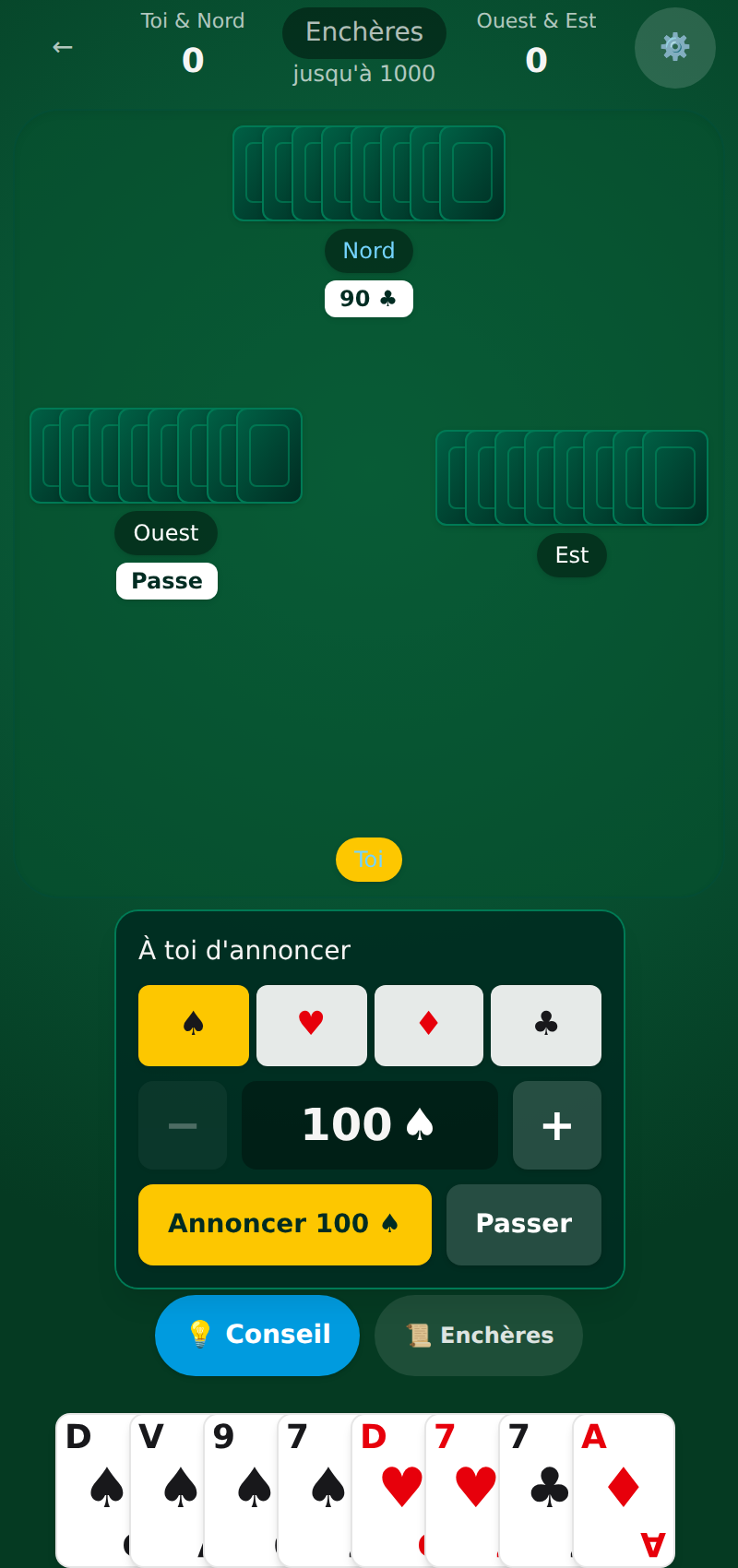 Want to practise? Play coinche online for free: tunable AIs and a coach are waiting for you on Coincheur.
See also
FAQ
Why do players say "never under an ace"?
Because leading small under your ace lets an opponent win with a weaker card, and your ace may then get ruffed afterwards.
Is leading under the ace always bad?
No. It can help to play your partner's suit or to keep your ace as a safe entry. It's a thought-out choice, not a rule.
What about trumps: can you lead under the ace?
In trumps, the ace is only the third card, behind the jack and the nine. The saying "never under an ace" is mainly about non-trump suits, where the ace is the highest card.