Supporting your partner's bid
Updated
When your partner bids, your hand is no longer alone: it completes theirs. To support is to add your strength to theirs in the suit they chose.
What does supporting mean?
Supporting means raising the bid in your partner's suit because you also hold useful cards there. You tell them: "I have something to help, we can aim higher." It's one of the foundations of team play.
What to support with
- One or two trumps in their suit, especially high ones.
- A side ace that brings a sure trick.
- A possible ruff (a short suit) that adds tricks.
By how much to raise?
No fixed scale. Modest help justifies a small step (from 80 to 90, say); real fit can justify a sharper jump. The goal isn't to inflate the contract at any cost: over-support can lead to an unmakeable contract. Better to describe your strength honestly and let your partner adjust. Several support levels are often defensible.
Example: your partner opens 80 in hearts
You hold the ace and 8 of hearts, the ace and king of spades, a lone 7 of clubs, and queen-9-8 of diamonds. Before answering, count what you really bring:
- The ace of hearts: a high trump that will often win a trick and strengthens your partner's trumps.
- The ace of spades: a likely trick on the first round of the suit.
- The lone 7 of clubs: from the second round of clubs, you can ruff with your 8 of hearts.
- The rest: the king of spades and your diamonds are useful late in the deal at best. Don't count them as tricks.
You see two to three tricks of help. A guideline common at many tables is to raise by about 10 per sure trick you bring: 100 is defensible, 90 is a more cautious version. If you play a specific system with your partner, that system takes precedence.
Support guidelines (adapt them)
| What you hold | Common reading |
|---|---|
| The jack or 9 of their suit | Strong help: your partner may not have these cards, and they change everything. |
| A side ace | Roughly one more trick. |
| A short suit + a small trump | A likely ruff, so a potential trick. |
| One small trump, nothing else | Light help: passing is often defensible. |
The common mistake is supporting twice with the same cards: if you already raised to show your ace of spades, don't raise again next round on that same ace. Your partner has already counted it. To go further, see when to bid above your partner.
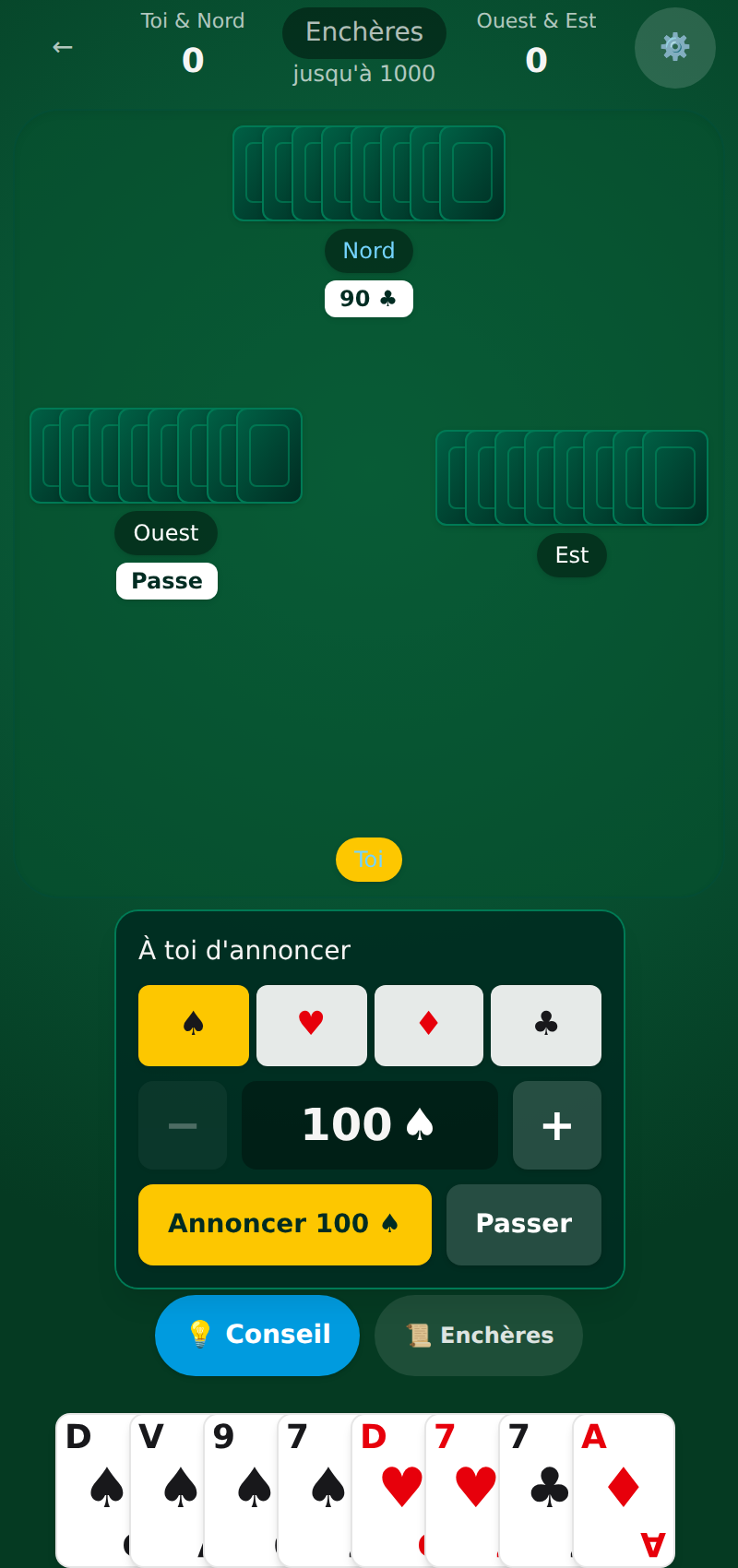 Want to practise? Play coinche online for free: tunable AIs and a coach are waiting for you on Coincheur.
See also
FAQ
Should you support as soon as you have a trump in their suit?
A single small trump is light support. Support depends on quality: high trumps, side aces or a ruff weigh far more than one isolated trump.
Can you over-support?
Yes. Overrating your help sometimes pushes the contract too high, toward failure. Describe your real strength rather than bidding out of enthusiasm.
What if I hold the jack of their trump suit?
It's one of the best kinds of help, since the jack is worth 20 and stays master. Many players show it with a clear raise, but the exact level depends on the rest of your hand and your agreements.