Trick-taking games: definition and examples
Updated
Belote, coinche, tarot, bridge... many games share one mechanic: the trick. Here is what a trick-taking game actually is.
What is a trick?
A trick is one round where each player lays a card, one after another. Whoever played the strongest card (by rank and, often, a trump suit) wins the trick and gathers the cards. You play trick after trick until hands run out.
The shared rule: follow suit
In most trick-taking games you must follow the suit led if you can. Otherwise, depending on the game, you ruff with trump or discard. That constraint is what creates the thinking: anticipating, counting cards, keeping the right one for the right moment.
Examples of trick-taking games
- Belote and coinche: 32 cards, 4 players in 2 teams, with trumps.
- Tarot: 78 cards, one taker, dedicated trumps.
- Manille: a 2-team trick-taking game popular in southern France and Belgium.
- Whist and bridge: English-language trick-taking games in 2 teams.
Most of these games rank among the great French card games.
Where does coinche fit?
Coinche is a trick-taking game for 4 players in 2 teams (32 cards, 8 tricks per deal) that adds an auction before play: you bid a contract from 80 up to capot, then try to make it with your partner. That bidding layer is what sets it apart from plain belote and rewards reading the table.
It is a great gateway into trick-taking games: the core mechanic is easy to grasp, yet the strategy keeps growing. Read the rules of coinche, see how it compares in the coinche vs contrée page, or simply play a game.
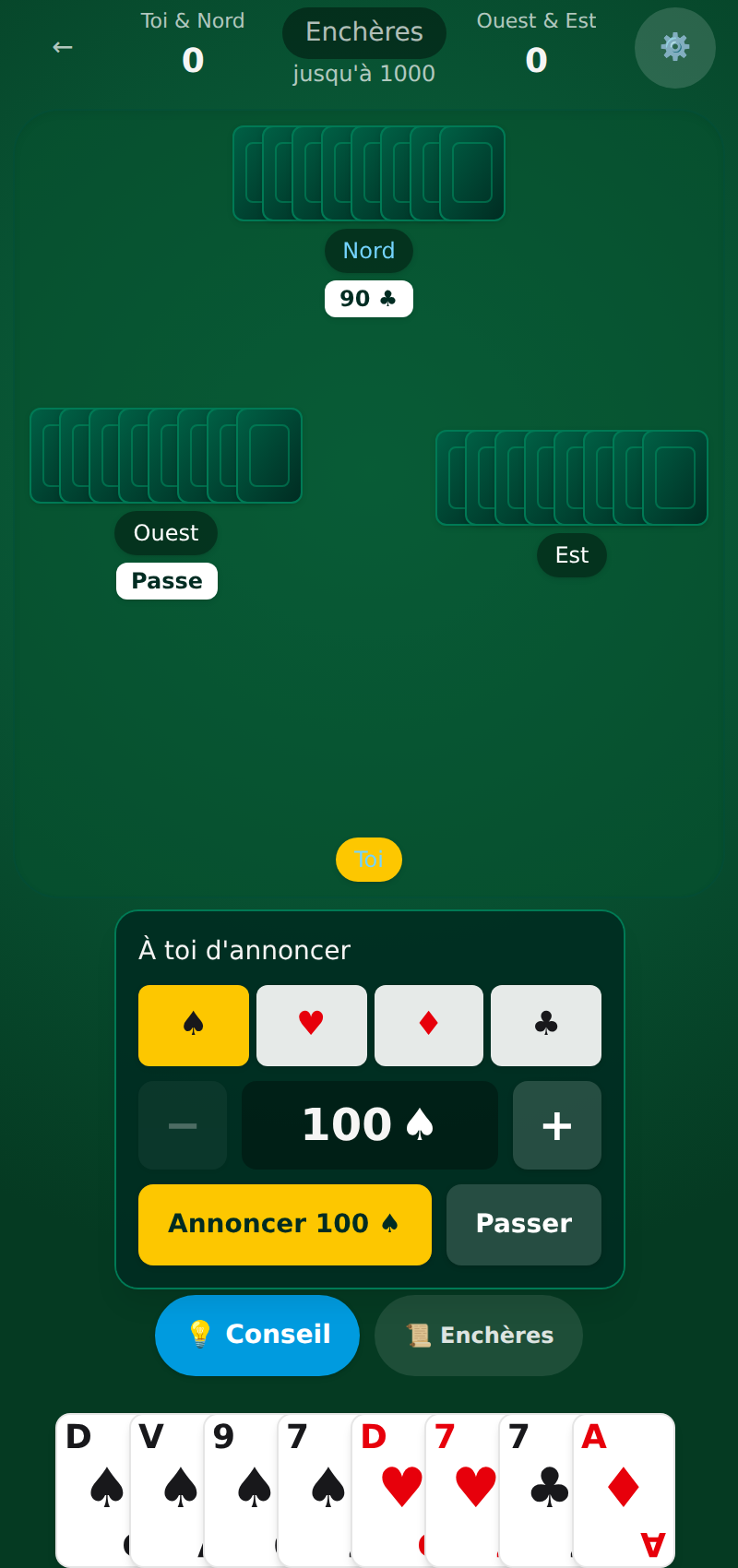 Want to practise? Play coinche online for free: tunable AIs and a coach are waiting for you on Coincheur.
See also
FAQ
What is a trick-taking game?
A game played in rounds: each round (trick), everyone plays a card and the strongest one wins the trick. Belote, coinche, tarot and bridge are trick-taking games.
Is coinche a trick-taking game?
Yes. Coinche is a trick-taking game for 4 players in 2 teams, with 32 cards, 8 tricks per deal and a bidding phase.