Coinche vs manille: what is the difference?
Updated
Manille and coinche are both four-player trick games in 2 teams, but their card ranking and their relationship to bidding differ clearly.
Card ranking
Manille's main quirk is that the 10 (the manille) is the strongest card, ahead of the ace (the manillon). Coinche keeps belote's ranking: in trump, the jack rules, followed by the nine, then the ace. This reversal changes the whole reading of the game when switching between them.
Bidding and trump
Classic manille is often played without true bidding, with trump set by turn-up or convention. Coinche, by contrast, relies on a bidding phase (80 up to capot) where you choose trump, with the option to coincher (x2) and surcoincher (x4).
| Coinche | Manille | |
|---|---|---|
| Top trump | the jack | the 10 (manille) |
| Bidding | 80 up to capot | often none |
| Doubling | coinche x2 | varies by variant |
How points are counted
The two games score very differently. In manille, only five cards per suit carry points: 10 (manille) 5, Ace (manillon) 4, King 3, Queen 2, Jack 1, so 15 per suit and 60 points per deal. Each team scores what it made above 30, half the total. In coinche, a deal is worth 162 points (152 in the cards + 10 for the last trick) and everything revolves around the bid contract: the declarer must reach it, otherwise the defence scores 162 + the contract.
| Coinche | Manille | |
|---|---|---|
| Points per deal | 162 | 60 |
| Most valuable card | Trump jack (20) | 10, the manille (5) |
| Goal of a deal | make the contract | score above 30 |
For the coinche side in detail, see the card values and the scoring table.
Team communication
In both games, playing as a duo means understanding your partner without speaking. In manille, some variants (spoken manille) allow agreed announcements to flag your strong cards, making it a lively communication game. In coinche, information flows mainly through the bidding and then through the cards you choose to play: opening a suit, ruffing or discarding are all signals to your partner. Reading these cues well is what separates a good pair from a great one in either game.
Who is it for?
Manille appeals through its easy access and conviviality: you learn fast and play relaxed. Coinche adds betting and doubling, which suits players who enjoy bidding and risk assessment. Both reward partnership and reading the game. If you like manille, coinche offers an extra strategic layer without relearning everything from scratch: start with the coinche rules, then place it among its neighbours in our guide to French trick-taking games.
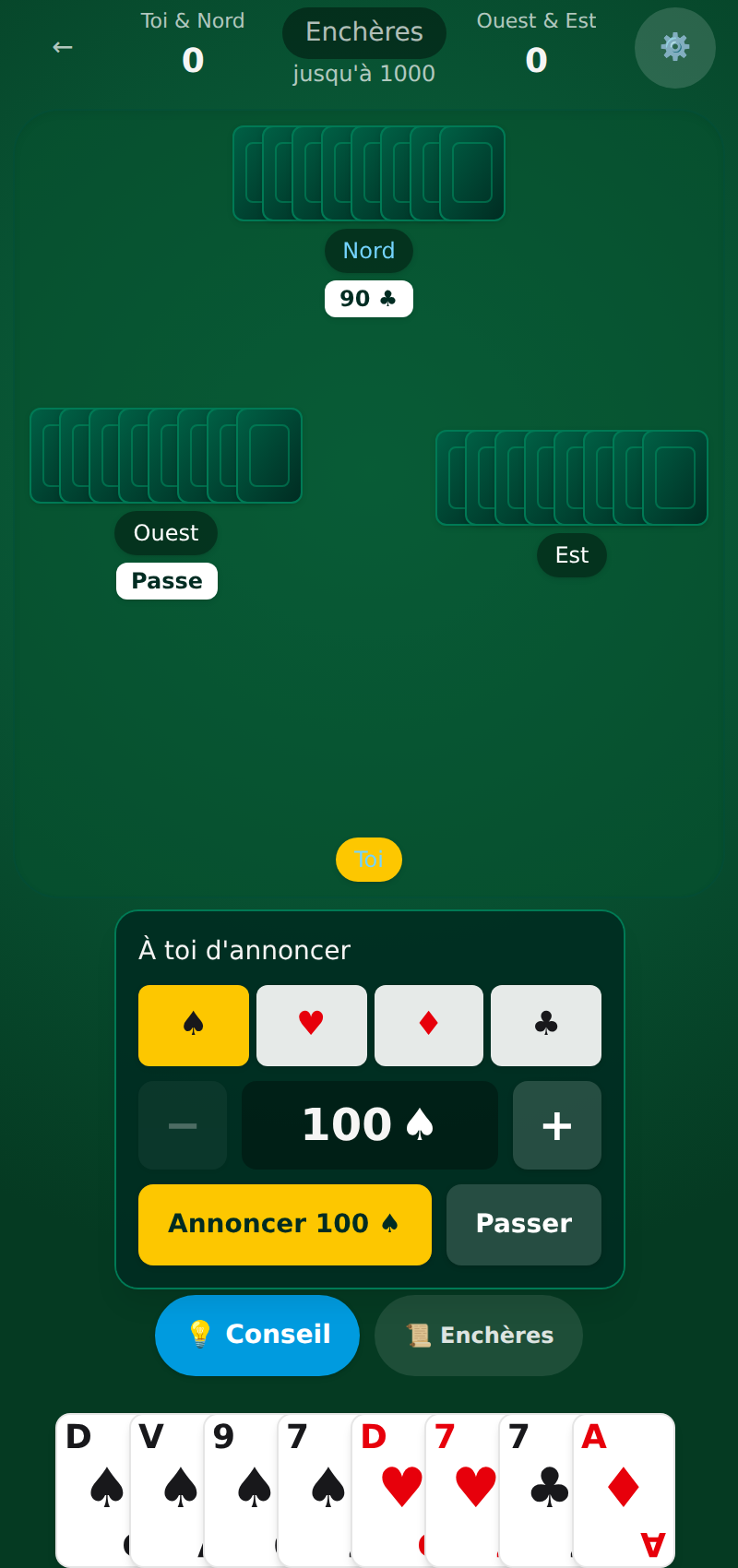 Want to practise? Play coinche online for free: tunable AIs and a coach are waiting for you on Coincheur.
See also
FAQ
What is the strongest card in manille?
The 10, called the manille, ahead of the ace called the manillon. This differs from coinche, where the trump jack rules.
Does manille have bidding like coinche?
Classic manille is often played without a true bidding phase, unlike coinche which relies on calls from 80 up to capot.