Coinche vs whist: the differences
Updated
Whist is an English classic often seen as the ancestor of bridge. Compared to coinche, it shares team play but parts ways on cards and bidding.
Cards and structure
Whist is played with 52 cards and 13 tricks per deal, by 4 players in 2 teams, like bridge. Coinche uses 32 cards and 8 tricks. In its simplest form, whist has no elaborate bidding phase and trump can be set by a turned-up card.
| Coinche | Whist (classic) | |
|---|---|---|
| Cards | 32 | 52 |
| Tricks/deal | 8 | 13 |
| Trump | set by bidding | often by turn-up |
| Doubling | coinche x2 | by variant |
Bidding and variants
There are many whist variants, some adding bidding (such as Boston whist). But coinche's central idea, betting a number of points and being able to coincher the opponent, is its own hallmark and has no direct equivalent in classic whist.
A historical influence
Whist deeply shaped the family of trick games: bridge descends from it, and bridge in turn inspired coinche's bidding phase and doubling. So when you play coinche, you are handling, without knowing it, a heritage that goes back to this English classic. Understanding whist helps you grasp where the shared core principles come from: following the led suit, ruffing with trump, and cooperating with your partner to win the most valuable tricks.
Spirit
Whist emphasises pure card-play technique and implicit communication with your partner. Coinche adds the spice of bidding and doubling, creating swings absent from classic whist. Both are great ground to develop memory, anticipation and a sense of partnership, qualities that transfer from one trick game to another.
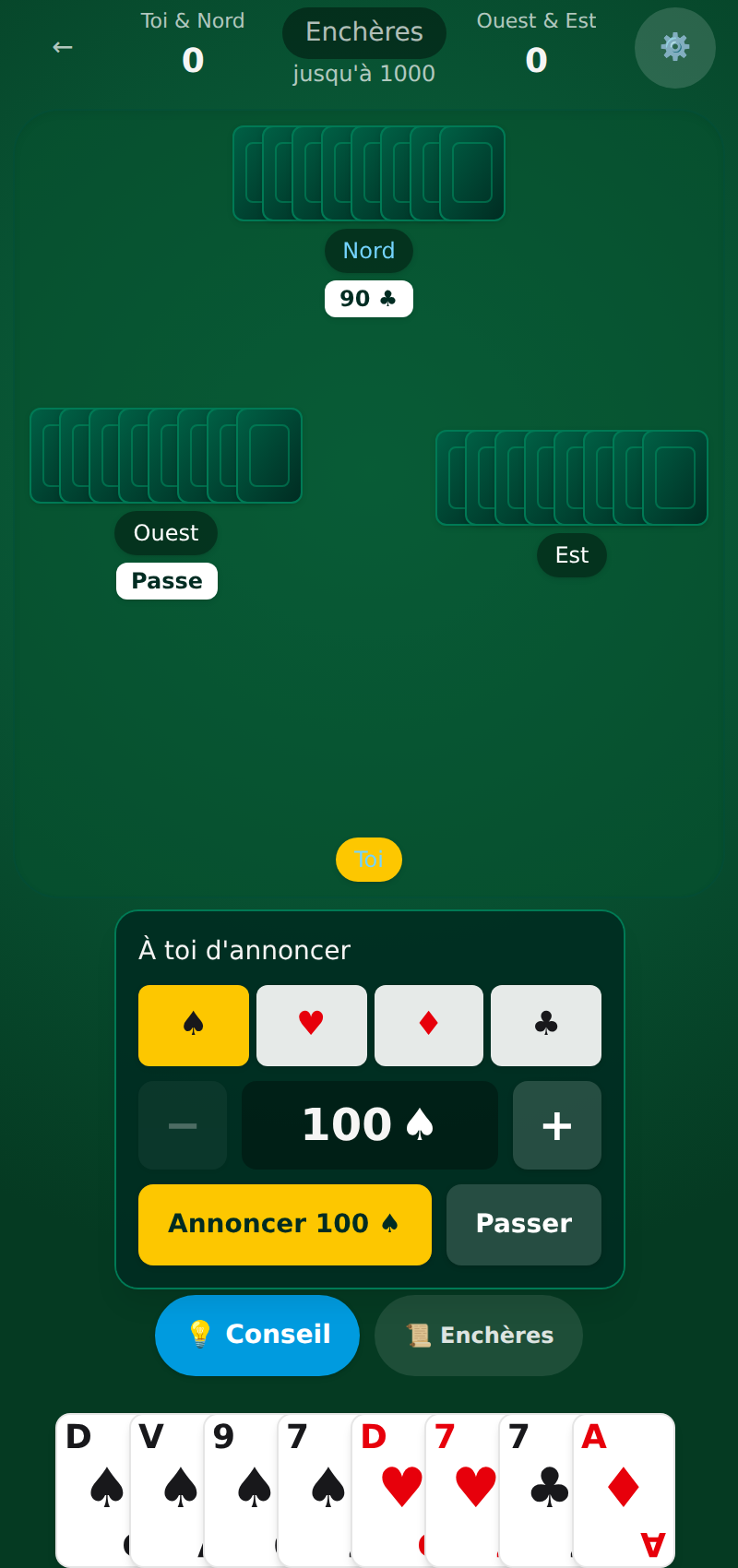 Want to practise? Play coinche online for free: tunable AIs and a coach are waiting for you on Coincheur.
See also
FAQ
Is whist the ancestor of bridge?
Whist is often presented as a forerunner of bridge. Coinche, for its part, descends from belote and borrowed the bidding phase from bridge.
Does whist have a doubling system like coinche?
Classic whist has no doubling comparable to coinche. Some variants add bidding, but doubling remains a signature of coinche.