French card games: the panorama
Updated
France has a rich card-game tradition. Here is an honest panorama of the great classics and where they sit.
The pillars of French card games
| Game | Players | Cards | Idea |
|---|---|---|---|
| Belote | 4 (2 teams) | 32 | simple trick game with trumps |
| Coinche | 4 (2 teams) | 32 | belote + auction |
| Tarot | 3 to 5 | 78 | one taker against the rest |
| Manille | 4 (2 teams) | 32 | regional trick game |
What they share
They are mostly trick-taking games: you win rounds by playing the strongest card, often with a trump that beats the other suits. Belote, coinche and manille are played by 4 in 2 teams with a 32-card deck; tarot uses a larger deck (78 cards) and a different flow, with a lone taker against the rest.
In all of them you generally have to follow the suit led if you can, which is what creates the thinking: counting cards, reading the others' hands and placing the right card at the right moment.
Coinche, the best of belote
Coinche (also called contract belote) takes belote and adds an auction: each team bids a contract from 80 up to capot, then tries to make it. That extra strategy is what makes it so popular. To see the nuance, read coinche vs contrée and contract belote.
Which one to start with?
If you're a beginner, coinche is a great pick: accessible rules, quick games and lasting depth, all while keeping the familiar 32-card deck. You learn the basics in one game, then keep improving for years thanks to the bidding. Try it free against the AI on Coincheur, browse the rules of coinche, or read up on the strategy before your next round.
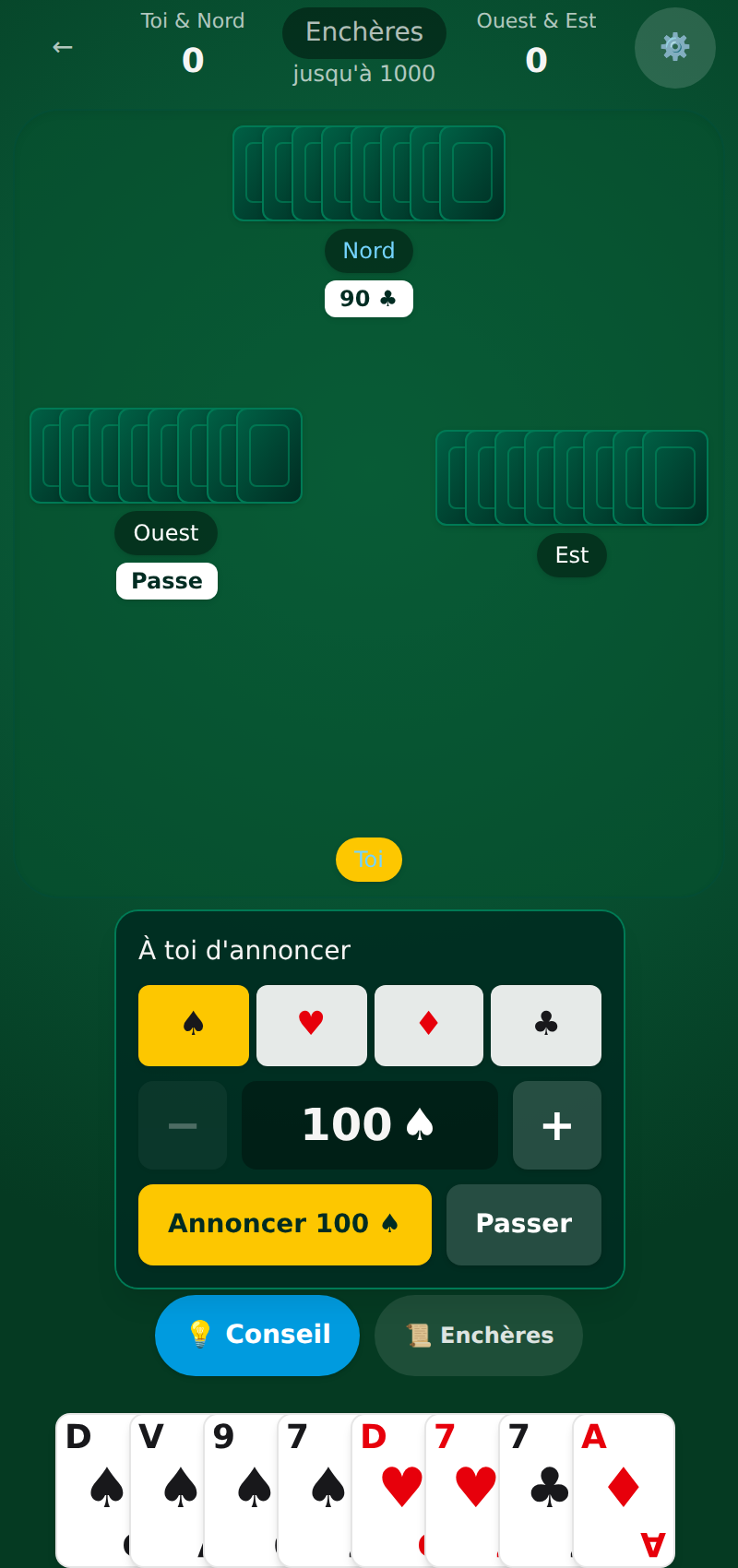 Want to practise? Play coinche online for free: tunable AIs and a coach are waiting for you on Coincheur.
See also
FAQ
What are the best-known French card games?
Belote, coinche (contract belote), tarot and manille are among the great French classics, all descended from the trick-taking tradition.
What's the difference between belote and coinche?
Coinche is belote enriched with a bidding phase: you bid a contract from 80 up to capot before play, which adds a genuine strategic layer.