The surcoinche in coinche
Updated
The surcoinche is the bidding team's comeback when it gets coinched: it multiplies the contract's value by 4.
Coinche, then surcoinche
When the defence coinches (betting you'll fail), the contract's value is already doubled. If you're confident, you can fire back with a surcoinche: you confirm you'll make your contract, and the contract is then multiplied by 4 instead of 2.
Who can surcoinche
Only the team that took the contract can surcoinche, and only after being coinched. Depending on the table, that's the declarer alone or either partner; on Coincheur, the declarer is the one who surcoinches. It's a bid of confidence: you surcoinche when you're nearly sure to make the contract. There's nothing beyond it: after the surcoinche, play begins.
The stakes
The surcoinche changes the whole scale of the deal. Contract made: the bonus is quadrupled, huge. Contract failed: the defence pockets the quadruple instead. At a high level, surcoinching is rare and sends a clear signal, so handle it with real composure. A reckless surcoinche can flip a match in a single deal, either way: only call it when your hand and your partner's bid make the outcome nearly certain.
Worked example: 100 in hearts, doubled then redoubled
North-South are playing 100 in hearts. Here's what gets scored in each case, using the scale on coincheur.fr (the winning side scores 162 plus the multiplied contract):
| Case | Contract made | Contract failed |
|---|---|---|
| No coinche (North-South take 110 points) | North-South 110 + 100, so 210; East-West 52 | East-West 162 + 100, so 262 |
| Coinched (×2) | North-South 162 + 200, so 362 | East-West 362 |
| Surcoinched (×4) | North-South 162 + 400, so 562 | East-West 562 |
Plus any belote. Other tables multiply all the points of the deal rather than just the contract: the figures change, but the order of magnitude stays. In a game to 1000 or 1500, one surcoinche can be enough to swing the match.
What the surcoinche doesn't change
Redoubling doesn't make the contract any easier or harder: you still have to reach its value (100 here) and, under the usual scale, outscore the defence. Only the stakes grow. Before calling it, ask yourself two things: how many tricks are genuinely safe, and what made the opponent coinche? If they spotted a weakness you missed, you're better off playing quietly at ×2. For detailed guidelines, see when to surcoinche.
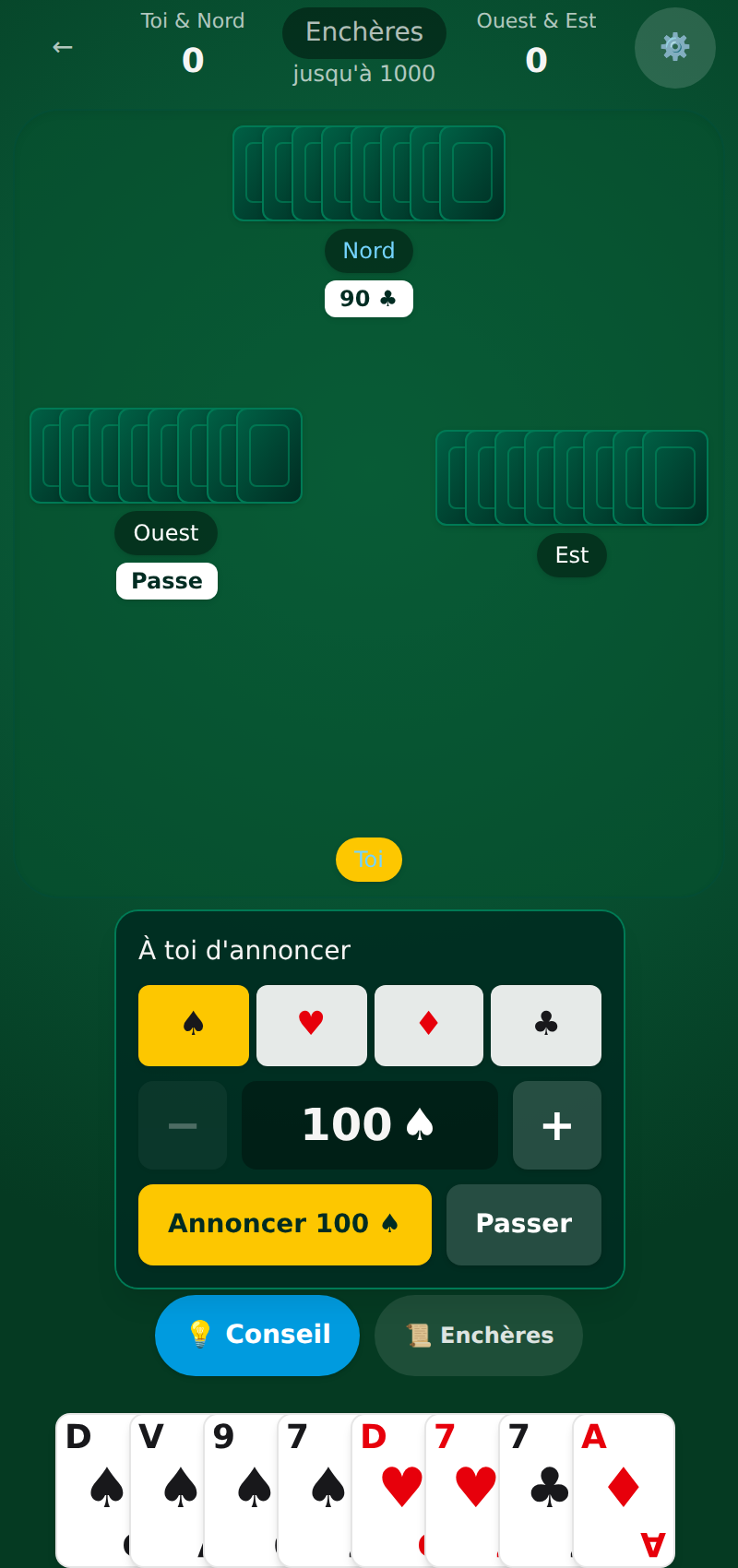 Want to practise? Play coinche online for free: tunable AIs and a coach are waiting for you on Coincheur.
See also
FAQ
What is a surcoinche?
It's the bidding team's reply to an opponent's coinche. It confirms they will make their contract and multiplies the contract's value by four instead of two.
Who can surcoinche and when?
Only the team that took the contract can surcoinche, and only after being coinched by the defence, before the first card is played.
How much is a surcoinched 100 worth?
On the coincheur.fr scale, 162 + 100 × 4, so 562 points for the winning side, whether that's the declarer (made) or the defence (failed). Tables that multiply all the points get different figures.
Can the declarer's partner surcoinche?
It depends on the table: by convention, either only the declarer or either of the two partners may call it, after the opponents' coinche and before the first card. On Coincheur, the declarer is the one who surcoinches.