The 80-all tie in coinche
Updated
When each team scores 81 points (the famous "80 all"), you need a tiebreaker: it's the bidding team that has to make the difference.
How the tie arises
The 162 points of a deal split between the two teams. If the split lands exactly at 81 versus 81, neither team has a clear majority. This case, nicknamed "80 all," needs a clear tiebreak rule, otherwise an argument is guaranteed.
The common rule: the bidder must exceed
The most widespread rule (and the one Coincheur applies): to make its contract, the bidding team must reach its bid and score strictly more than the defence. At 81-81 it did reach 80, but not the majority: its contract fails and the defence scores 162 + 80. The case only arises with an 80 contract: from 90 upwards you need more than 81 points anyway.
The "litige" rule and conventions
Some tables use a rule called litige: the deal's points are set aside and go to the team that wins the next deal. Others settle immediately in the defence's favour. Since conventions vary, set the rule before playing to avoid conflict.
If the discussion turns sour, our method to settle a dispute in a coinche game helps you decide calmly.
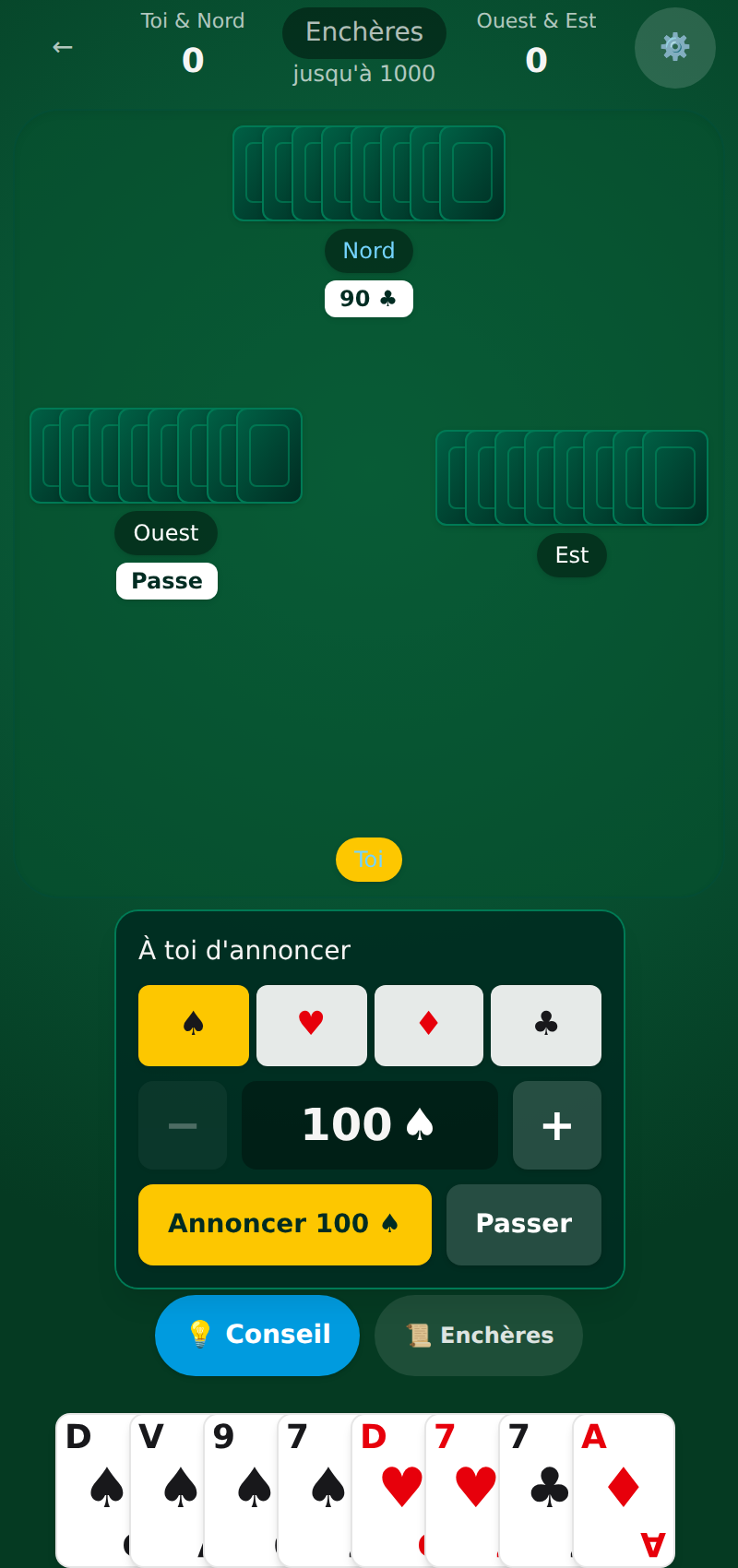 Want to practise? Play coinche online for free: tunable AIs and a coach are waiting for you on Coincheur.
See also
FAQ
Who wins at 80 all (81-81) in coinche?
Most often the bidding team must score strictly more than the defence to succeed. At 81-81 it lacks the majority, so its contract fails, unless agreed otherwise.
What is the litige rule?
It's a convention where the points of an undecided deal (81-81) are held in reserve and go to the team that wins the next deal. Not every table uses it.