What you lose when the contract fails
Updated
When a contract fails, the team that took it scores 0, and the opponents collect 162 + the bid value.
What "going down" means
A contract fails when the team that took it doesn't reach its bid (for example, it bid 110 but only made 95). The contract is then lost, no matter how many tricks were won.
The failure scale
The most common calculation: the bidding team scores 0, and the defence scores 162 + the bid amount. Example: a failed 100 contract gives the defence 162 + 100 = 262 points. A belote (20) stays with the side holding it and is added depending on conventions.
With coinche or surcoinche
If the failed contract was coinched, only the contract is doubled: the defence scores 162 + 2 × the bid (362 for a coinched 100). Surcoinched, the bid is multiplied by 4 (562 for a 100). That's what makes a successful coinche so rewarding, and an overambitious bid so dangerous.
The bid capot case
A bid capot that fails (the opponents take at least one trick) hands the capot's value to the defence: it scores 162 + 250 = 412 points (252 + 250 = 502 if it takes every trick itself), with the contract multiplied if the deal was coinched.
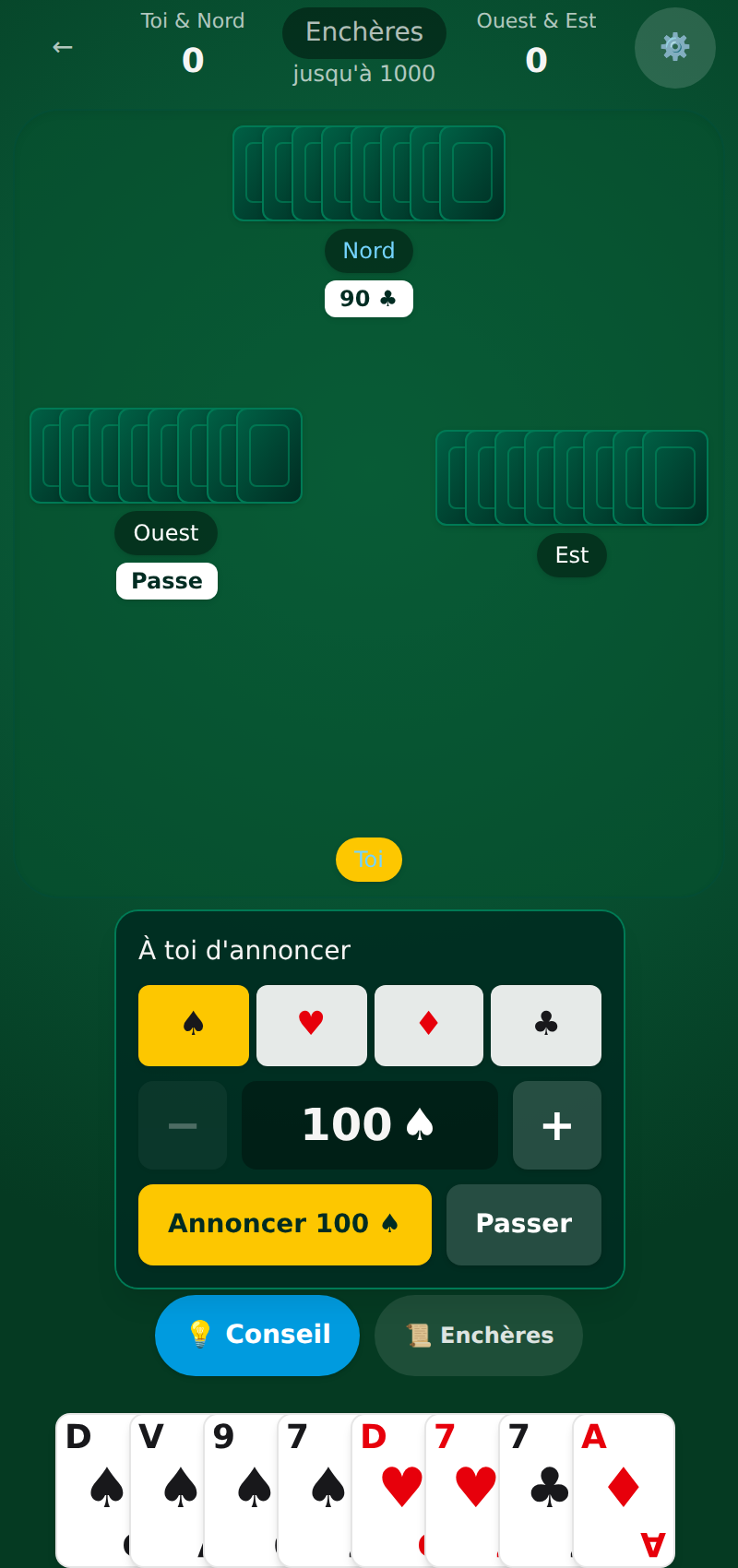 Want to practise? Play coinche online for free: tunable AIs and a coach are waiting for you on Coincheur.
See also
FAQ
How many points do you score when a contract fails?
The team that took it scores 0. The defence scores 162 plus the bid value. For example, a failed 100 contract gives the defence 262 points.
What happens if a coinched contract fails?
Only the contract is multiplied: the defence scores 162 plus twice the bid (362 for a coinched 100). With a surcoinche, the bid counts four times (562).