Leading trump on the very first trick: good idea?
Updated
Leading trump first is often useful when you took the contract, but it's not mandatory. It all depends on your hand and your plan.
Why draw trumps early
As declarer with a strong trump holding, leading trump early strips the opponents of their ruffs. Once their trumps are gone, your side aces and tens run safely. It's the classic line with a long, strong trump suit.
Which card to open trumps with
You don't always have to lead the biggest one. Opening the trump suit with the jack is far from a bad choice: you almost surely win the trick while keeping the nine and ace for later. But leading a low trump to probe the layout is also fine, especially if you fear a bad split.
When to hold off
- Short or weak trumps: drawing trumps disarms you before the opponents.
- You're counting on ruffs: keep small trumps to cut side suits.
- On defence: leading trump can help declarer pull yours. Think first.
Example: you took 100 in spades
Your hand: J♠ 9♠ A♠ 8♠, A♥ 10♥, A♣ and 7♦. You hold 4 of the 8 trumps, including the top three. The natural plan: knock out the opponents' trumps, then cash your aces and your ten of hearts with no risk of a ruff.
- Round 1, the jack: nobody can beat it. If the other three all follow, 4 trumps are gone. You still hold 3 (9, A, 8), so only one is left outside (8 - 4 - 3 = 1).
- Round 2, the nine: the last outside trump (10, K, Q or 7) is necessarily lower. It falls, and you keep the ace and the 8 of trumps.
- Then: A♥, 10♥ and A♣ run with no ruff possible, and your trump ace serves as an entry or as your card for the last trick.
If someone fails to follow on round 1, your count changes: 2 trumps remain outside, necessarily with the two players who did follow. Adjust from there.
Counter-example: keep your trumps to ruff
You took 90 in hearts with K♥ Q♥ 8♥ 7♥, A♠ 10♠ K♠, A♦ and no clubs. Here, leading trump is a classic mistake: the jack, nine, ace and ten are all outside, and every trump round costs you a small trump for nothing. Your real asset is the club void: your small hearts can ruff the opponents' clubs. A sensible line: cash A♠ and A♦, then let the clubs come to you and ruff them. Your belote (king and queen of trumps, 20 points) is scored anyway when you play those two cards.
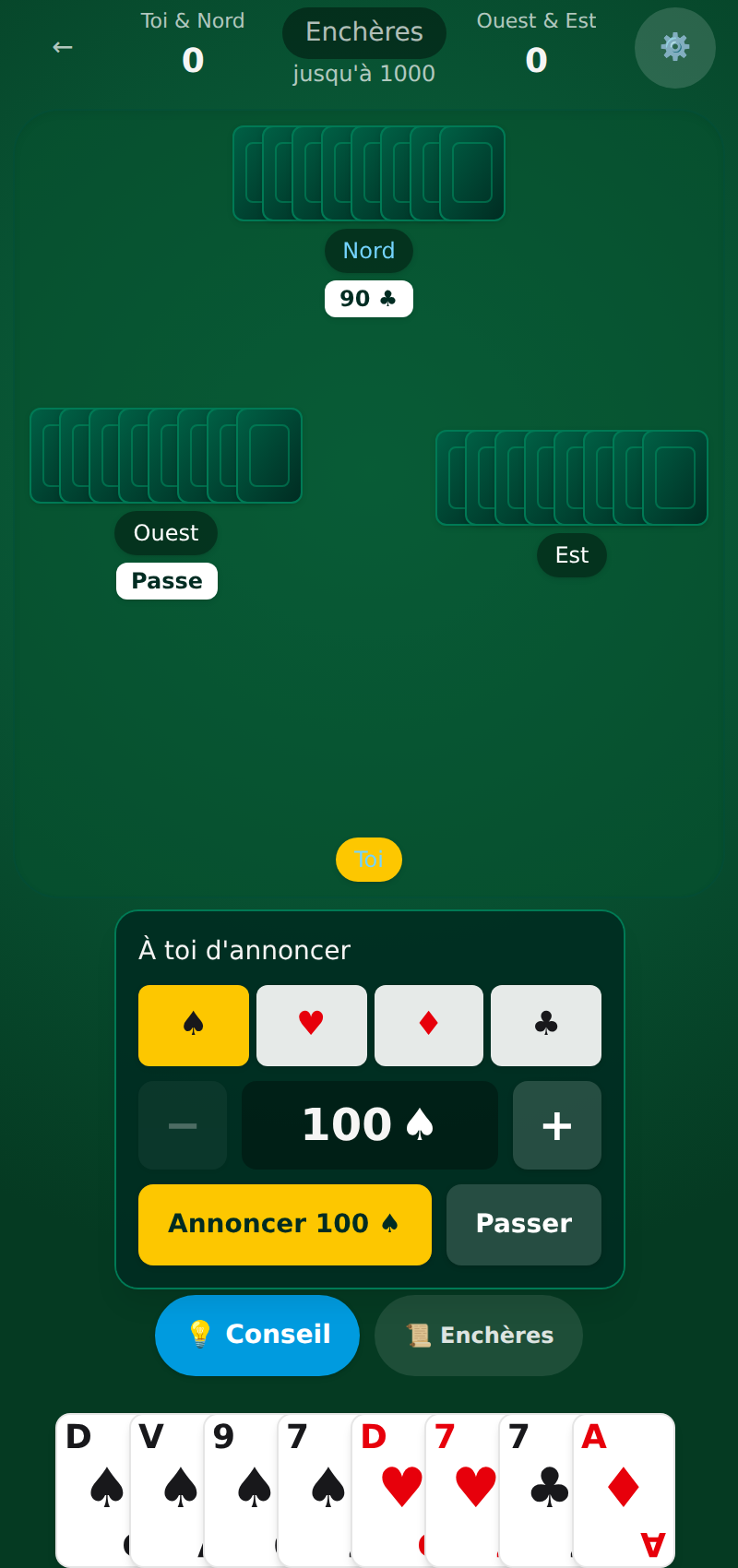 Want to practise? Play coinche online for free: tunable AIs and a coach are waiting for you on Coincheur.
See also
FAQ
Should you always lead trump on the first trick?
No. It's often good for declarer with many master trumps, but with few trumps or a ruffing plan, it's better to hold off.
Can you open trumps with the jack?
Yes, it's a perfectly sound line: you win the trick almost for sure while keeping the nine and ace for later.
How many rounds of trumps should declarer play?
As many as it takes to clear the opponents, no more. Count: 8 trumps in total, minus those in your hand, minus those already played. When none are left outside, switch to your side suits. Keep in mind that the remaining trumps may also be in your partner's hand.