The rules of contrée
Updated
Here are the rules of contrée in the order you actually need them at the table: deal, bid, play the tricks, count. The essentials, with nothing important left out.
Dealing and how a deal unfolds
Four players, two teams, 32 cards. The dealer gives out the whole deck in the direction of play, traditionally counter-clockwise (some tables go the other way round), 8 cards each, classically 3 then 2 then 3. After the auction, the player to the dealer's right leads the first trick. Everyone plays one card, the trick goes to the strongest according to the suit led and the trump, and its winner leads the next one. Eight tricks later the deal is over and you count.
The auction and the contract
Each player in turn bids higher than the previous bid, or passes. A bid combines a point target (80 to 160, then capot) and a trump: a suit, or no-trump, or all-trump depending on table conventions. When three players pass in a row, the last bid becomes the contract.
The taking team must score at least the announced points. The defence has one job: stop them. If you judge the contract unmakeable, you can counter (coincher): the deal then counts x2, and x4 after a surcoinche.
Obligations during play
Three rules settle almost every dispute in contrée:
- Follow the suit led if you hold a card in it.
- Ruff if you are void in the suit and an opponent is winning the trick. If your partner is winning it, you may usually discard instead.
- Overruff: when a trump has already been played and you ruff, you must play a higher trump if you have one.
Breaking these obligations is a revoke, and the deal is lost by the offender under whichever convention the table uses. The detail is in the complete rules.
Counting and checking the contract
A deal is worth 162 points: 152 in the cards and 10 for the last trick. Add 20 for belote, the King and Queen of trumps in the same hand. A capot (all 8 tricks) lifts the deal to 252; bid, it is a 250 contract, so 502 when made. Then compare the total scored with the contract: reach it and it is made; fall short and it fails, with the points going to the defence. The card-by-card scale is on card values.
What changes from table to table
Contrée is played with local conventions: declared melds (sequences, four of a kind), how a silent capot counts, the target that ends the match, who speaks after a counter. None of it is dramatic, provided you settle it before the first deal. If a doubt arises mid-game, rule for the current deal and write the convention down for later.
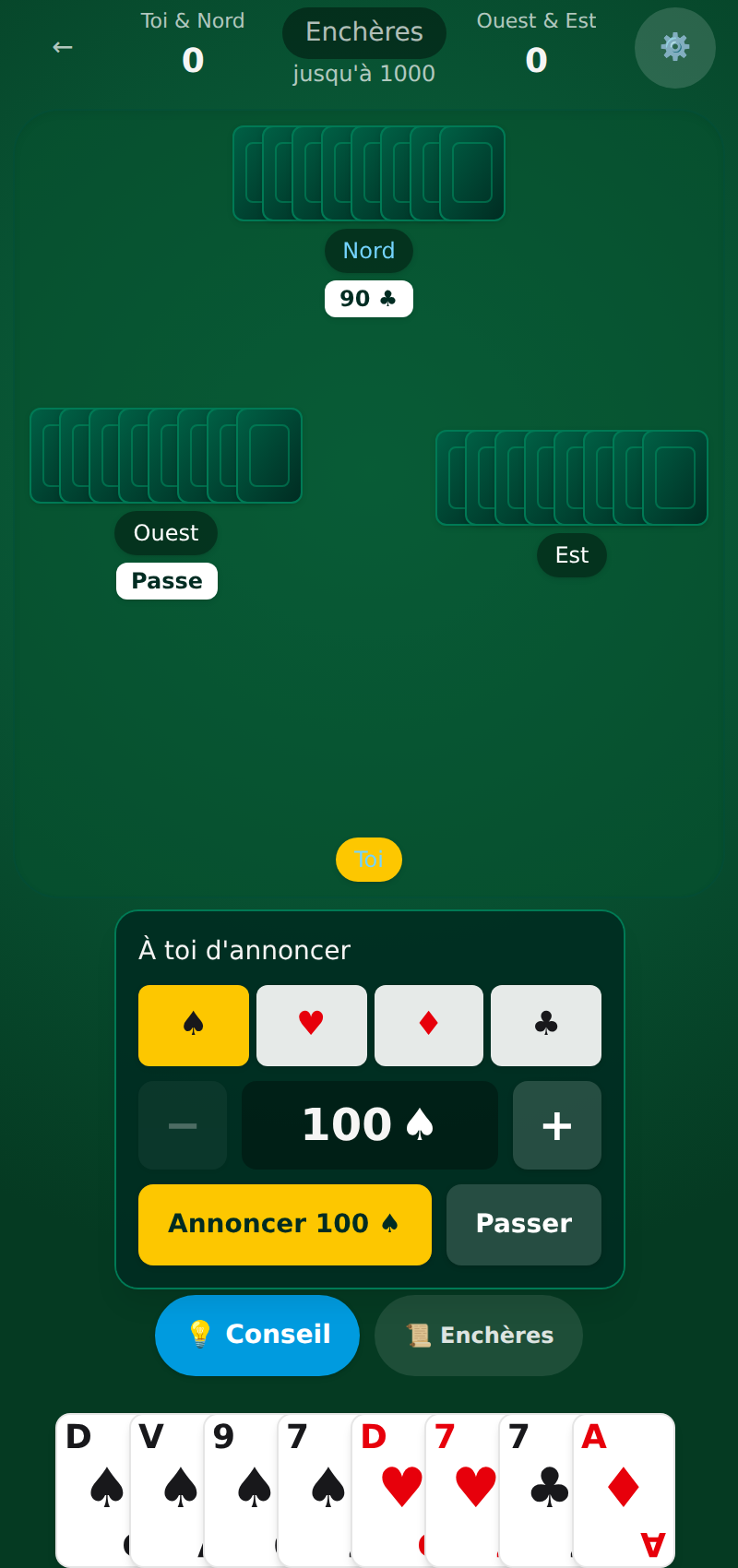 Want to practise? Play coinche online for free: tunable AIs and a coach are waiting for you on Coincheur.
See also
FAQ
What are the basic rules of contrée?
Four players in two teams, 32 cards, 8 tricks. You bid from 80 to capot while naming a trump, then play by following the suit led, ruffing when an opponent is winning, and overruffing when you can. A deal is worth 162 points.
Can any contract be countered in contrée?
Yes, the defence can counter the announced contract, which doubles the deal's points. The taking team may then re-counter (surcoinche), which quadruples them.
What happens if the contract fails?
The taking team scores nothing for the deal and the points go to the defence, following the agreed scale, doubled after a counter and quadrupled after a re-counter.