Do you have to overruff?
Updated
It depends on the convention: in the strictest version, yes, you must overruff (play a higher trump) when you ruff after an opponent.
What "overruffing" means
To overruff is to play a higher trump than the one already on the table. The question arises when you can't follow the led suit, an opponent has already ruffed, and you hold trumps.
The strict rule
In the most common version of the rules, you must overruff if you can, that is, play a trump higher than the opponent's. If you only hold weaker trumps, you must still play one (you "undertrump" by obligation) for lack of a better option.
Convention: overruff only over opponents
The duty to overruff applies only when an opponent leads the trick. If your partner ruffed and is master, you don't have to overruff them. Some tables relax the rule and don't require overruffing at all: agree before the game to avoid disputes.
A concrete example
Trumps are spades. One opponent leads a heart, the other has none and ruffs with the Queen of spades. You have no hearts either.
- You hold the 9 and 8 of spades: the 9 beats the Queen (trump order is J, 9, A, 10, K, Q, 8, 7). Under the strict rule, you must play the 9.
- You only hold the 8 and 7 of spades: you can't beat the Queen. At most tables you must still play a trump, known as undertrumping. You pick which one.
- You have no trumps left: discard whatever you like.
Worth noticing: overruffing with the 9 puts 14 points in the trick. Great if it holds, but if the last player has the Jack, you've just handed them those points. The rule forces you, so better to have seen it coming by counting the trumps played.
Summary table (most common rule)
| Situation | What you must play |
|---|---|
| Trump led, you hold a trump higher than those played | A higher trump, even if your partner is winning |
| Trump led, you only hold lower trumps | Any trump |
| Side suit led that you lack, an opponent has ruffed | A higher trump if possible, otherwise a lower one |
| Side suit led that you lack, your partner is winning | Anything you like (common convention) |
The first row often surprises people: when trumps are led, many tables require you to go higher even over your partner's Jack or 9 if you can. Others relax it. For the ruffing rule itself, see the obligation to ruff.
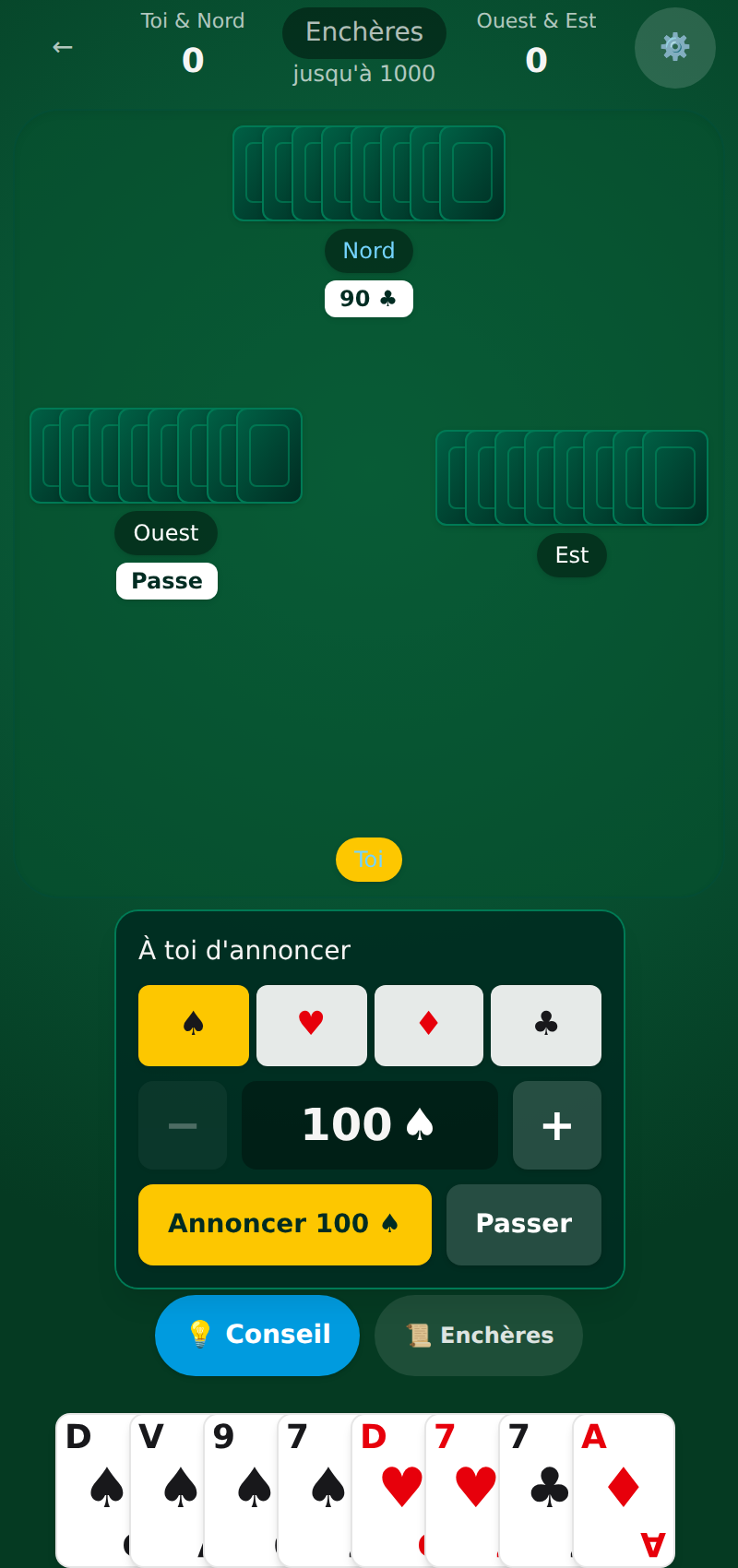 Want to practise? Play coinche online for free: tunable AIs and a coach are waiting for you on Coincheur.
See also
FAQ
Must you overruff in coinche?
In the strict version of the rules, yes: if an opponent has ruffed and you can play a higher trump, you must. Some tables don't enforce this.
Do you have to overruff your partner's trick?
No. The duty to overruff only applies to tricks led by an opponent. If your partner is master, you don't overruff them.
Must I go higher when trumps are led and my partner is winning?
Under the most widespread rule, yes: on a trump lead you must beat the highest trump in the trick if you can, even if it's your partner's. Some tables relax this.
What does undertrumping mean?
It's playing a trump lower than the one already on the trick, when you can't follow suit and can't overruff. Most tables require it; others then allow a free discard.