Contrée or coinche: why two names?
Updated
You say « contrée », your cousin says « coinche », and yet you play exactly the same game. Here is where the names come from and where each is heard.
Two words, one original verb
Both names describe the same act: challenging the opposing contract. « Contrer » (to counter) comes from mainstream card-game vocabulary, while « coincher » is a regional form of the same move. Hence « belote contrée » and « belote coinchée », two ways of saying « the belote where you may counter ». Over time each region shortened its own version: la contrée here, la coinche there.
The geography of the names
- Contrée: widespread in the South, from Marseille to Toulouse, across Provence and the Mediterranean coast. Plenty of southern players never say « coinche » at all.
- Coinche: more common in the North, the East, around Lyon and in French-speaking Switzerland, where chibre names a close cousin.
- Belote contrée or belote coinchée: the full forms, found in clubs, tournaments and rule books.
These borders are blurry and shift as people move. Our page on regional names of coinche maps the areas and local variants.
Do the rules change with the name?
No. Whether you call it contrée or coinche, you play four-handed with 32 cards, bid from 80 to capot, name the trump and count 162 points a deal. What does change from table to table are the local conventions: declared melds, how a silent capot counts, the match target. Those vary from village to village, not from name to name. The detailed comparison is on coinche, contrée and belote: the differences, and the overview on contract belote.
Which name to use, and why it matters
Simplest rule: keep the word your table uses. When searching online, try both, because many guides exist under only one name and you would miss half the material. And if you are teaching someone from the South, say « la contrée »: that is the word they know. For practice, the game is the same on Coincheur, whichever name you give it.
To put it into practice, you can play contrée online for free, with the contrée rules at hand.
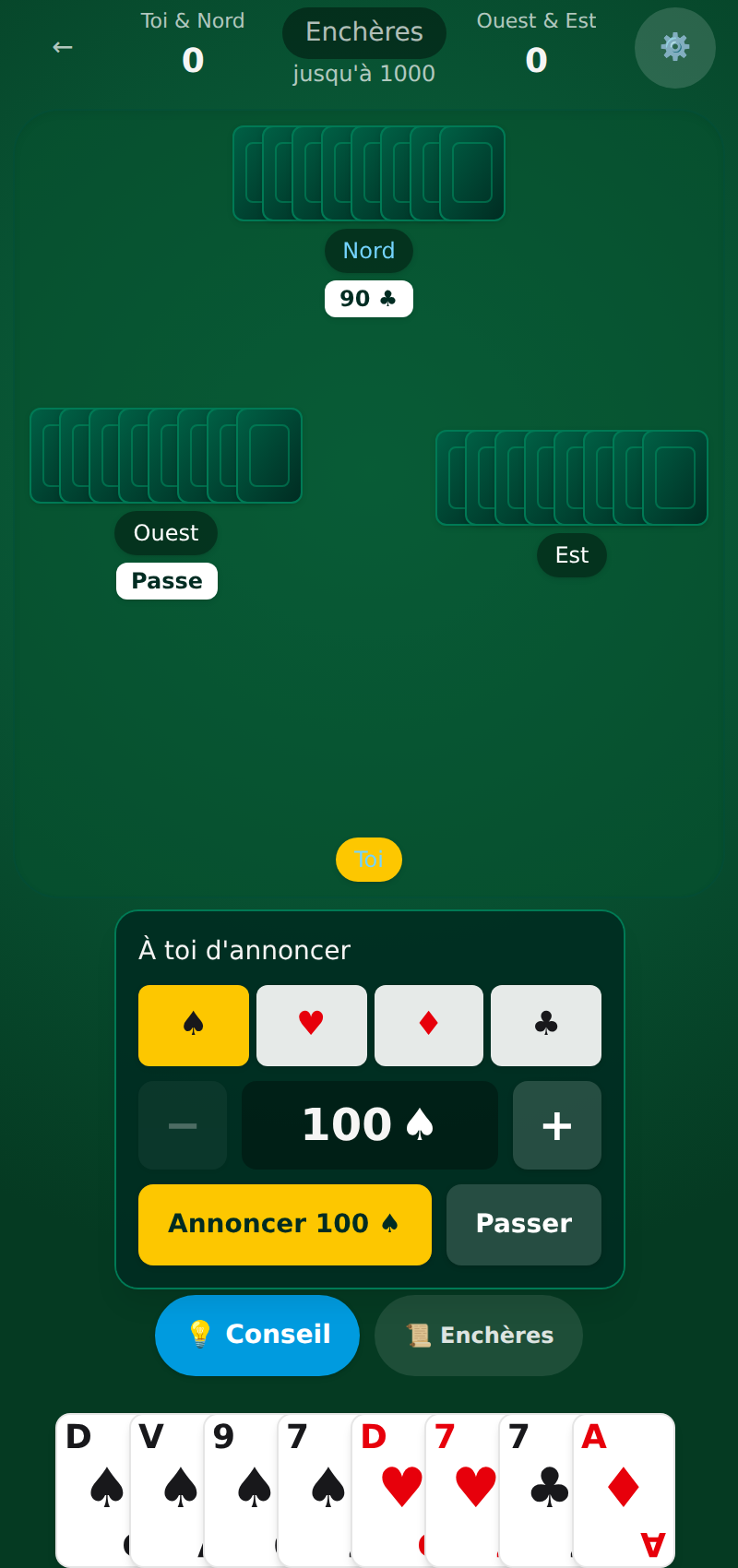 Want to practise? Play coinche online for free: tunable AIs and a coach are waiting for you on Coincheur.
See also
FAQ
Are contrée and coinche the same game?
Yes, exactly the same. They are two regional names for a bidding belote in which you may counter the opposing contract. Only table conventions vary, never because of the name.
Where do people say « contrée » rather than « coinche »?
Mostly in the South of France: Provence, the Marseille area, Languedoc and the Mediterranean coast. « Coinche » is heard more in the North, the East and French-speaking Switzerland.
Where does the word « contrée » come from?
From the verb contrer, to counter: the defence can counter the announced contract and double the deal's points. « Coincher » is the regional form of the same move, hence « belote coinchée ».