When to redouble?
Updated
To surcoinche is to answer an opponent's coinche by taking the contract to ×4. The stake quadruples, and so does the penalty.
The mechanic
When the opponents coinche you (×2), you may surcoinche to push the stake to ×4. You're claiming your contract will make despite their challenge. If you hold, the gain is huge; if you fail, the loss is just as big.
When it's justified
- You're very confident in your contract: master trumps, well-placed aces, suit control.
- The opponents' coinche looks presumptuous given what you hold.
- Your partner has shown support and you know where the tricks are.
Caution still applies
Surcoinching isn't about pride. An opponent often coinches for a real reason: ignoring that signal to hit back out of ego is a classic mistake. A surcoinche can be brilliant or disastrous. Judge coldly, weigh the score, and accept that a plain "we'll make it" without redoubling is sometimes the best choice.
What a surcoinche really weighs (worked example)
On Coincheur, as soon as there is a coinche or a surcoinche, the winning team scores 162 + the contract value multiplied (×2 or ×4), and the losing team scores nothing (apart from belote, which stays with whoever holds it). The multiplier applies to the contract only, not to the 162. Take a contract of 100 in hearts:
| Situation | Contract made | Contract failed |
|---|---|---|
| Normal | your card points + 100 (e.g. 110 + 100 = 210) | defence: 162 + 100 = 262 |
| Coinched (×2) | you: 162 + 200 = 362 | defence: 162 + 200 = 362 |
| Surcoinched (×4) | you: 162 + 400 = 562 | defence: 162 + 400 = 562 |
Going from coinched to surcoinched therefore swings 200 extra points one way or the other. Depending on the target score (1000, 1500 or 2000), a single deal can almost settle the match. Some tables also double the 162: check your table's rule before you go for it.
Sample hand: redouble or just play?
You took 100 in hearts holding J-9-A-10 of hearts, the ace of spades, the ace of clubs, the king of clubs and an 8 of diamonds. Your partner supported you, and an opponent coinches. Think it through step by step:
- Trumps: you hold the top four (jack, nine, ace, ten). The opponents share at most four trumps, none of which beats yours.
- Side suits: two aces, so two likely tricks on the first round of each suit.
- Partner: their support suggests at least one more trick or ruff.
- Weak spot: the singleton 8 of diamonds, which the opponents can attack, but which also gives you a quick ruff.
Here, a surcoinche is easy to defend. Now change the hand: J-A-K of hearts, a single side ace, no support. The opponent's coinche may well rest on the nine and ten of trumps. In that case, playing the contract at ×2 without redoubling is a reasonable choice, arguably the wisest one.
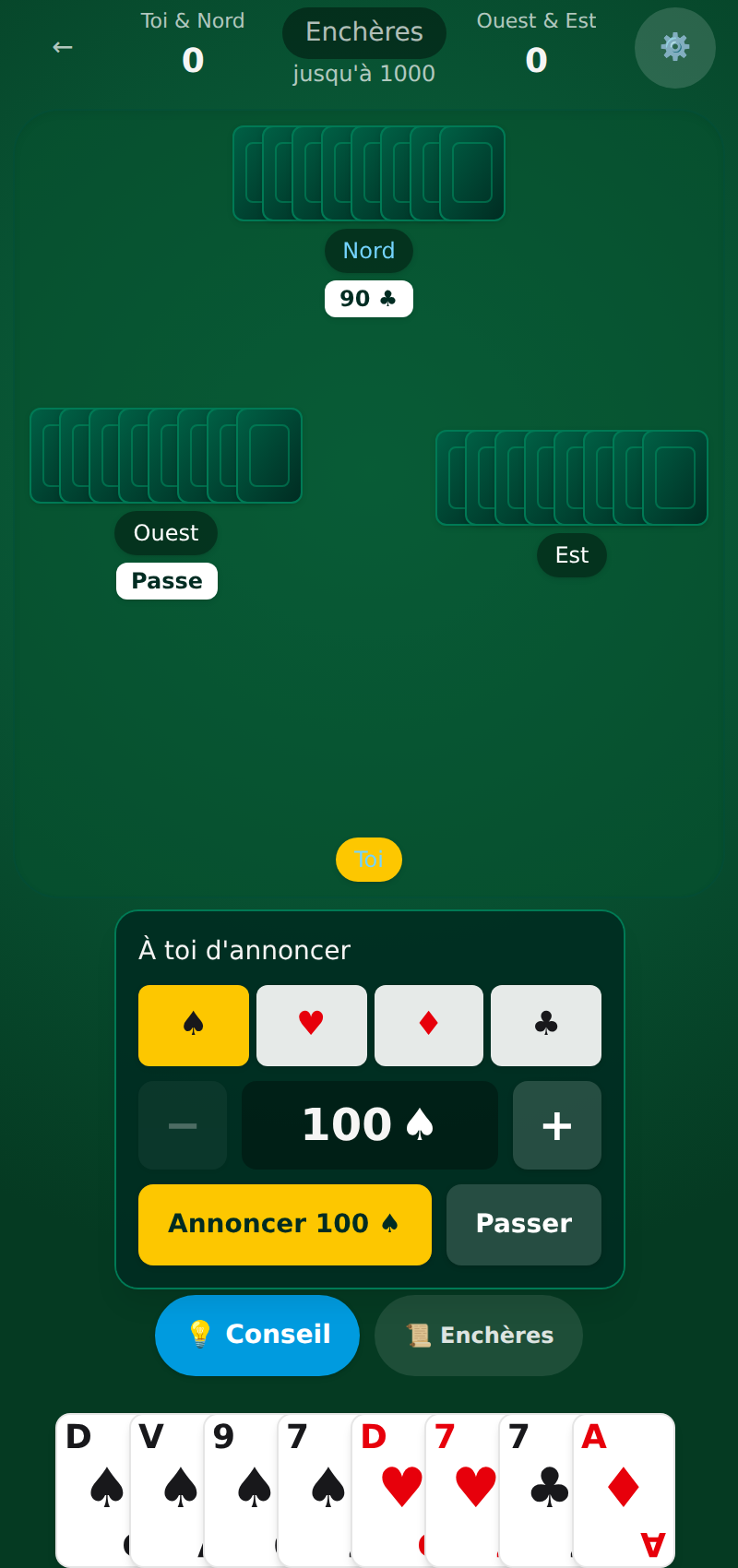 Want to practise? Play coinche online for free: tunable AIs and a coach are waiting for you on Coincheur.
See also
FAQ
How much does surcoinching multiply the points?
Surcoinching takes the contract points to ×4 (quadruple), in answer to the opponents' coinche which was at ×2.
Is surcoinching common?
No, it stays rare. It demands strong confidence in your contract, because the quadrupled stake makes the smallest mistake very costly.
How much do you lose if a surcoinched contract fails?
On Coincheur, the defence then scores 162 + the contract × 4. For a contract of 100, that's 162 + 400 = 562 points for the opponents, and nothing for you apart from belote.
Who can surcoinche?
Only the team that took the contract can surcoinche, and only after an opponent's coinche. It's an answer to a challenge, not a bid you can make at any time.