When to bid capot?
Updated
Bidding capot means promising all 8 tricks on a 250 contract (502 points when made). The most prestigious call, and the riskiest in the game.
What capot demands
To aim for capot you must control every suit: leave the opponents no opening. That means many master trumps (jack, nine, ace), side aces, and ideally the lead to run the deal at your pace. A single conceded trick fails the contract and hands 162 + 250 = 412 points to the opponents.
The partner's role
Capot is made by two. If your partner has shown a hand during the auction, yours needn't be perfect: their cards can plug the gaps. A capot bid on a well-matched pair is safer than one attempted solo on a brilliant but isolated hand.
Risk and alternatives
Capot can flip a match, but a single flaw makes it fail heavily. When in doubt, a high but realistic contract (140, 150, 160) often secures more points than a shaky capot. Mind the score: far behind, the capot gamble may be worth it; ahead, caution protects your lead. Several choices are defensible.
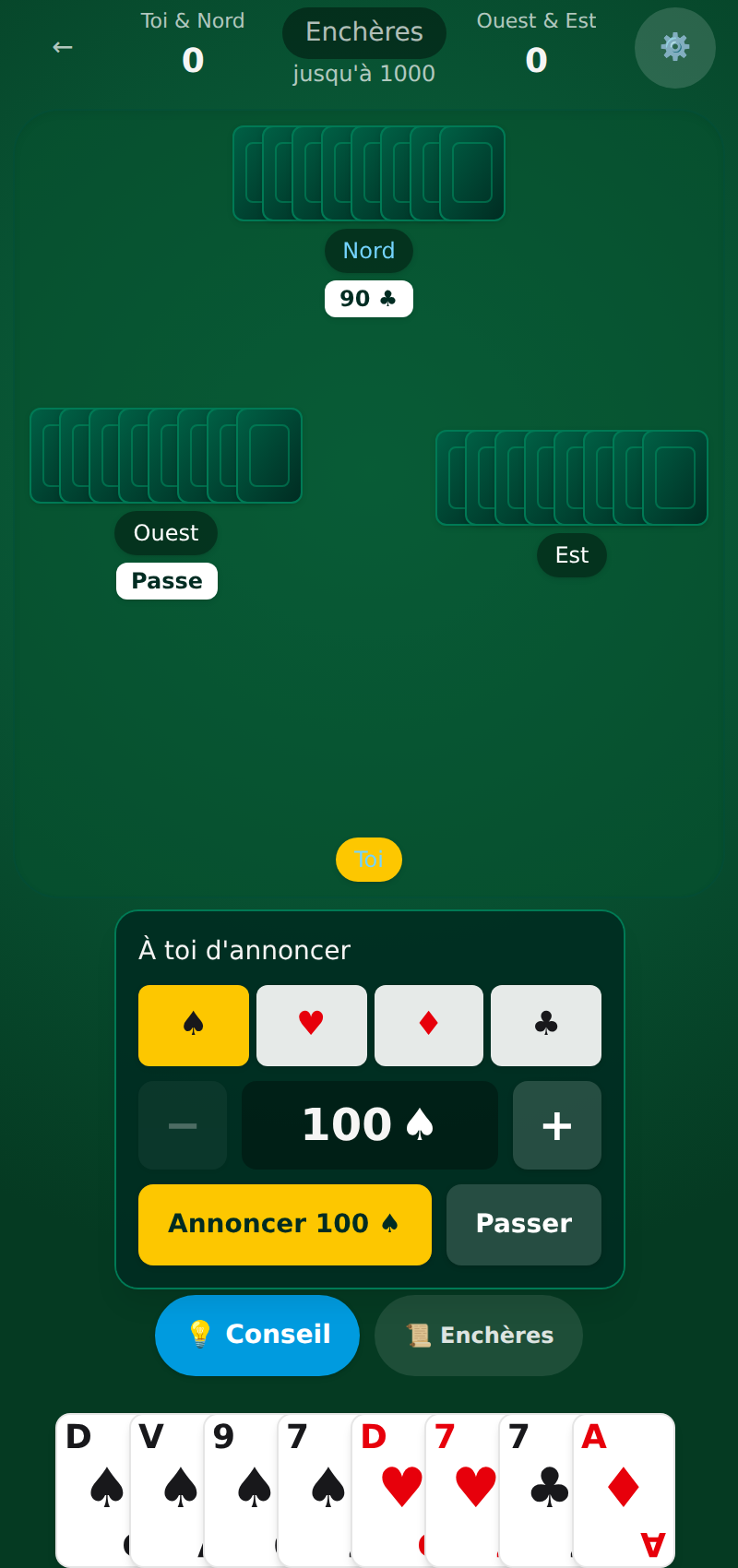 Want to practise? Play coinche online for free: tunable AIs and a coach are waiting for you on Coincheur.
See also
FAQ
How much does a bid-and-made capot score?
A bid capot is a 250 contract: made, the declarer scores 252 + 250, so 502 on the Coincheur scale. If it fails, even by one trick, the defence scores 162 + 250, so 412 (502 if it takes every trick itself).
Do you need a perfect hand to bid capot?
Not necessarily. If your partner has shown strength in the auction, a solid but imperfect hand can be enough, since their cards complete yours. It depends on the pair and the deal.