Dealing the cards in coinche
Updated
In coinche you deal the 32 cards in packets, usually in two or three rounds (3-3-2, 3-2-3, etc.), for 8 cards per player.
The principle
Each player gets 8 cards (4 players, 32 cards). You don't deal one at a time: tradition is to deal in small packets, counter-clockwise, starting with the player to the dealer's right. Some tables play the other way round: agree on it before the game (it's a setting in Coincheur).
The common patterns
| Pattern | Dealing rounds |
|---|---|
| 3-3-2 | 3 cards, then 3, then 2 |
| 3-2-3 | 3 cards, then 2, then 3 |
| 2-3-3 | 2 cards, then 3, then 3 |
All of them deal 8 cards per player. The exact pattern is a table convention; what matters is keeping the same one all game.
Cutting and shuffling
Before dealing, you shuffle and then have the deck cut by the opponent sitting to the dealer's left (the usual convention when dealing to the right). Cutting limits cheating and ensures randomness. A misdeal (wrong number of cards, a card flipped by mistake) usually means a redeal by the same dealer. Many tables don't even reshuffle between deals: you simply cut the gathered pile, which is part of the game's tactical charm.
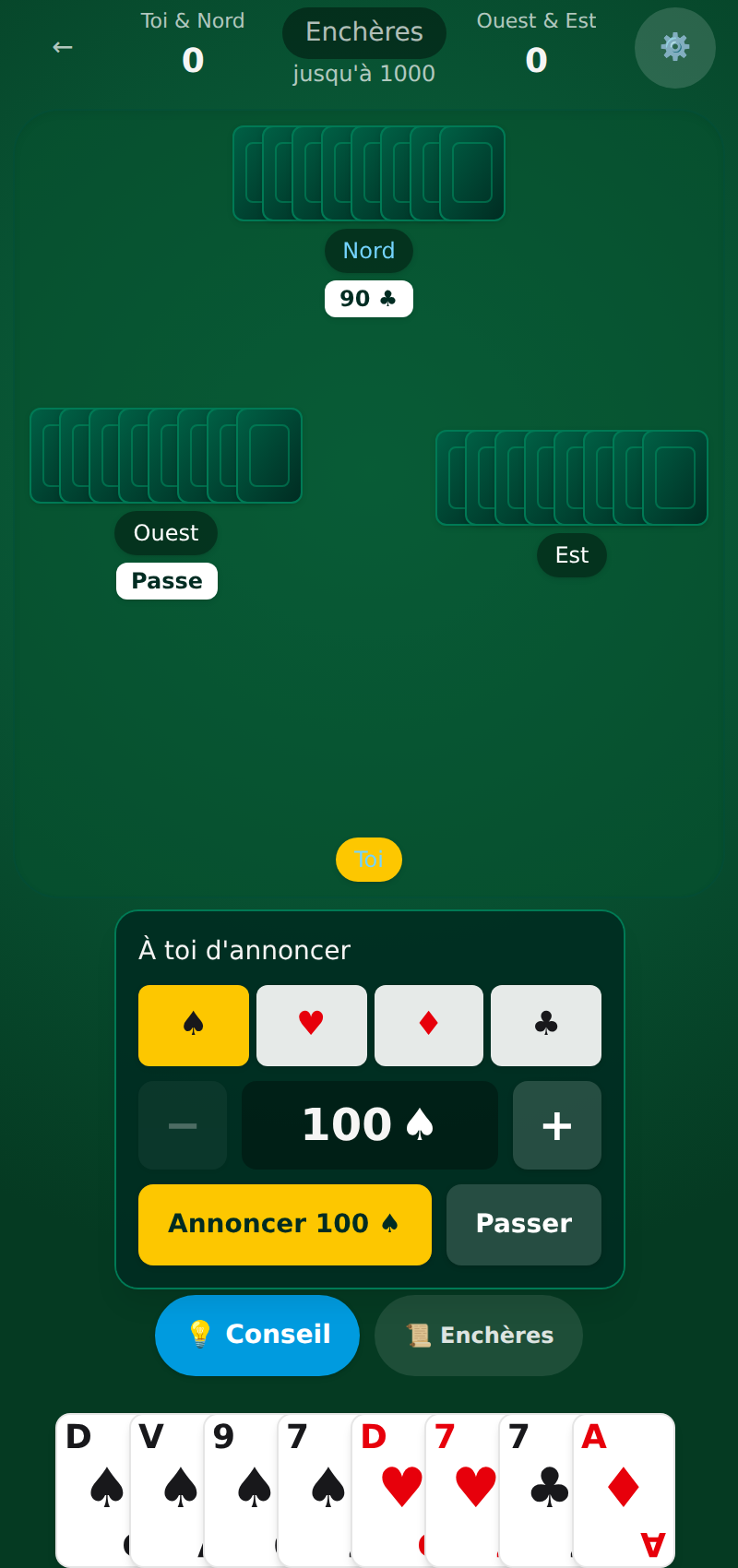 Want to practise? Play coinche online for free: tunable AIs and a coach are waiting for you on Coincheur.
See also
FAQ
How do you deal the cards in coinche?
You deal the 32 cards in small packets, usually over two or three rounds (3-3-2, 3-2-3, etc.), giving 8 cards to each player.
Should you deal one card at a time?
No, coinche tradition is to deal in packets of 2 or 3 cards in a constant direction. Dealing one at a time is not the custom.