The renonce (playing error)
Updated
A renonce (revoke) is a playing error: you break an obligation (follow, ruff, overruff) that you could have met.
Definition
Committing a renonce means playing a card the rules forbid: not following the led suit when you hold it, not ruffing when required, or not overruffing a trump where the convention demands it. In short, ignoring your playing obligations.
Typical examples
- You hold hearts (the led suit) but play a spade: renonce.
- You're void in the suit and hold trumps, but you discard without ruffing: renonce (except the partner-is-master case).
- You can overruff an opponent but play a low trump: possible renonce, depending on the overruff convention.
The penalty
The most common sanction: the offending team loses the deal, counted as failed (often 162 + the bid for the opponents). Some tables simply void the misplayed trick, others apply a precise tournament scale. Since conventions vary, agree on the renonce rule before playing.
A disputed renonce quickly turns into an argument: see how to settle a dispute in a coinche game.
Example: what a renonce costs
North-South are playing 100 in diamonds. On the sixth trick, East discards a club on a spade lead while still holding a spade. The revoke is spotted at the end of the deal.
Under the most common sanction, the deal is lost by the offending side, here the defence. North-South then score as if the contract had been made in full, often 162 + 100, so 262, and East-West score nothing, except possibly their belote depending on the table. Had North-South revoked instead, East-West would have scored the 262.
You can see what's at stake: one careless card can cost more than a whole deal. Hence the value of never rushing your play.
What is not a renonce
- Discarding when your partner is winning and you can't follow suit (common convention, see ruffing when your partner is master).
- Undertrumping, that is playing a low trump when you can't overruff.
- Following with a low card of the led suit while holding the Ace: in a side suit, you don't have to play higher.
- Playing any card when you hold neither the suit nor a trump.
In practice, a revoke is usually claimed before the cards are gathered for the next deal. After that, it can no longer be proven.
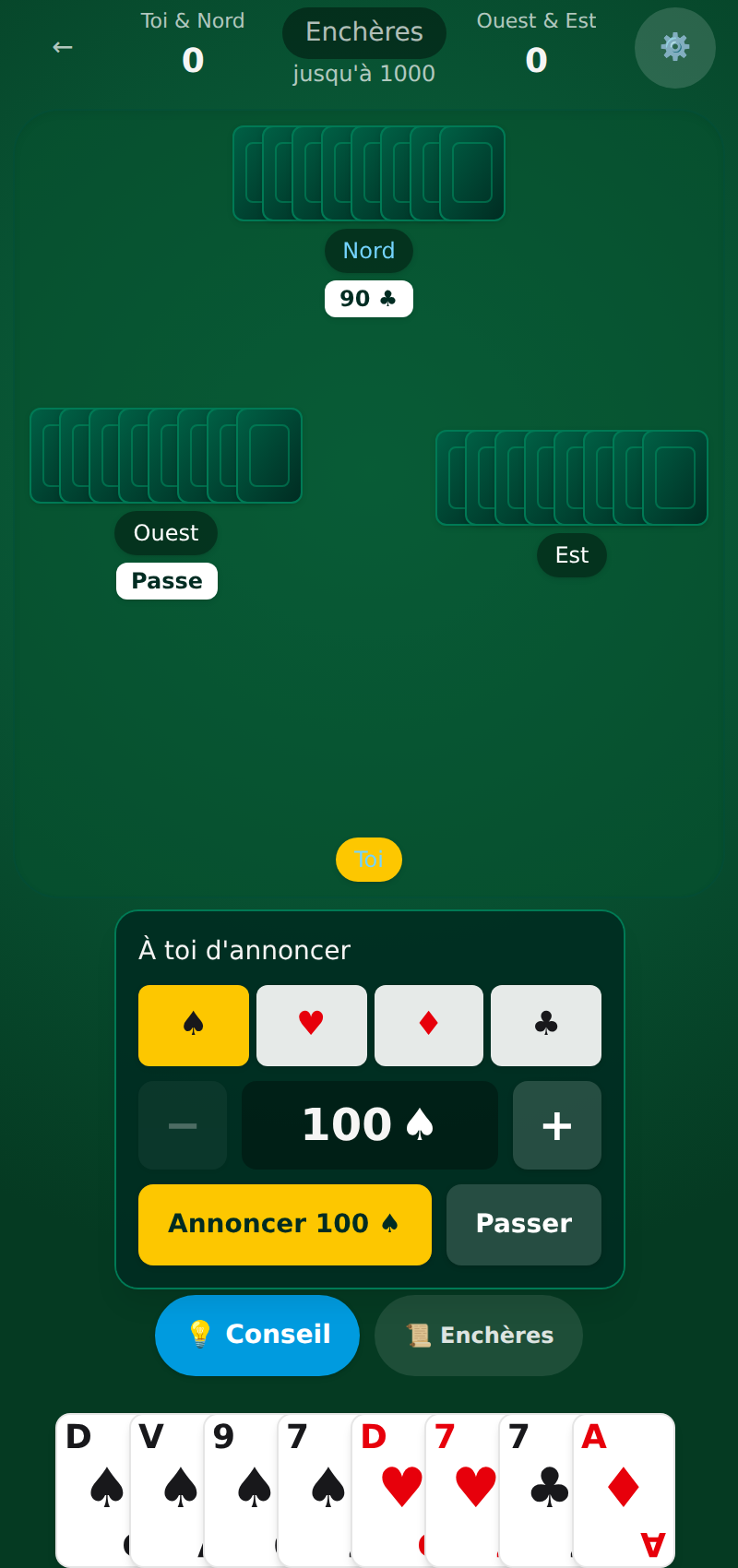 Want to practise? Play coinche online for free: tunable AIs and a coach are waiting for you on Coincheur.
See also
FAQ
What is a renonce in coinche?
It's a playing error: failing to follow the led suit, to ruff, or to overruff when the rules required it and you could have done so.
What is the penalty for a renonce?
Most often the offending team loses the deal, counted as failed for the opponents. The exact scale depends on the table or tournament conventions.
How long do you have to claim a renonce?
Usually until the tricks are gathered for the next deal, since they need to be turned over to check. Tables and tournaments sometimes set a more precise cut-off.
Is it a renonce not to play your Ace on the led suit?
No. In a side suit you must follow, but the choice of card is yours. The duty to play higher only applies to trumps.