Coinche vs bridge: the differences
Updated
Bridge inspired coinche's bidding phase, but the two games differ in deck size, depth of bidding and learning curve.
Deck and trump
Bridge uses the 52-card deck and 13 tricks per deal; coinche uses 32 cards and 8 tricks. In bridge, trump (or no-trump) emerges from an elaborate bidding system. In coinche, you announce a number of points (80 up to capot) while choosing trump, with no-trump and all-trump available in some variants.
| Coinche | Bridge | |
|---|---|---|
| Cards | 32 | 52 |
| Tricks/deal | 8 | 13 |
| Bidding | points (80 to capot) | level + suit |
| Doubling | coinche x2, surcoinche x4 | double / redouble |
Doubling, a shared idea
Both games let you double an opponent's call and redouble it. That is in fact where the name "coinche" comes from. The logic of betting and challenging feels familiar to players of either game.
The partner's role
In both games the partnership is central, but it shows differently. In bridge, one partner becomes the "dummy" and lays their hand face up, the declarer then playing two visible hands. In coinche, all four players keep their cards hidden from start to finish: coordination flows entirely through the bidding and the reading of played cards, without ever seeing your partner's hand.
Learning
Bridge is famous for its great depth, with codified bidding systems that take time and regular practice to master. Coinche offers some of that strategic tension on a base that is quicker to learn, inherited from belote. Both are excellent games; the choice depends on the time you want to invest and the mood you seek, more club and competition for bridge, more convivial for coinche.
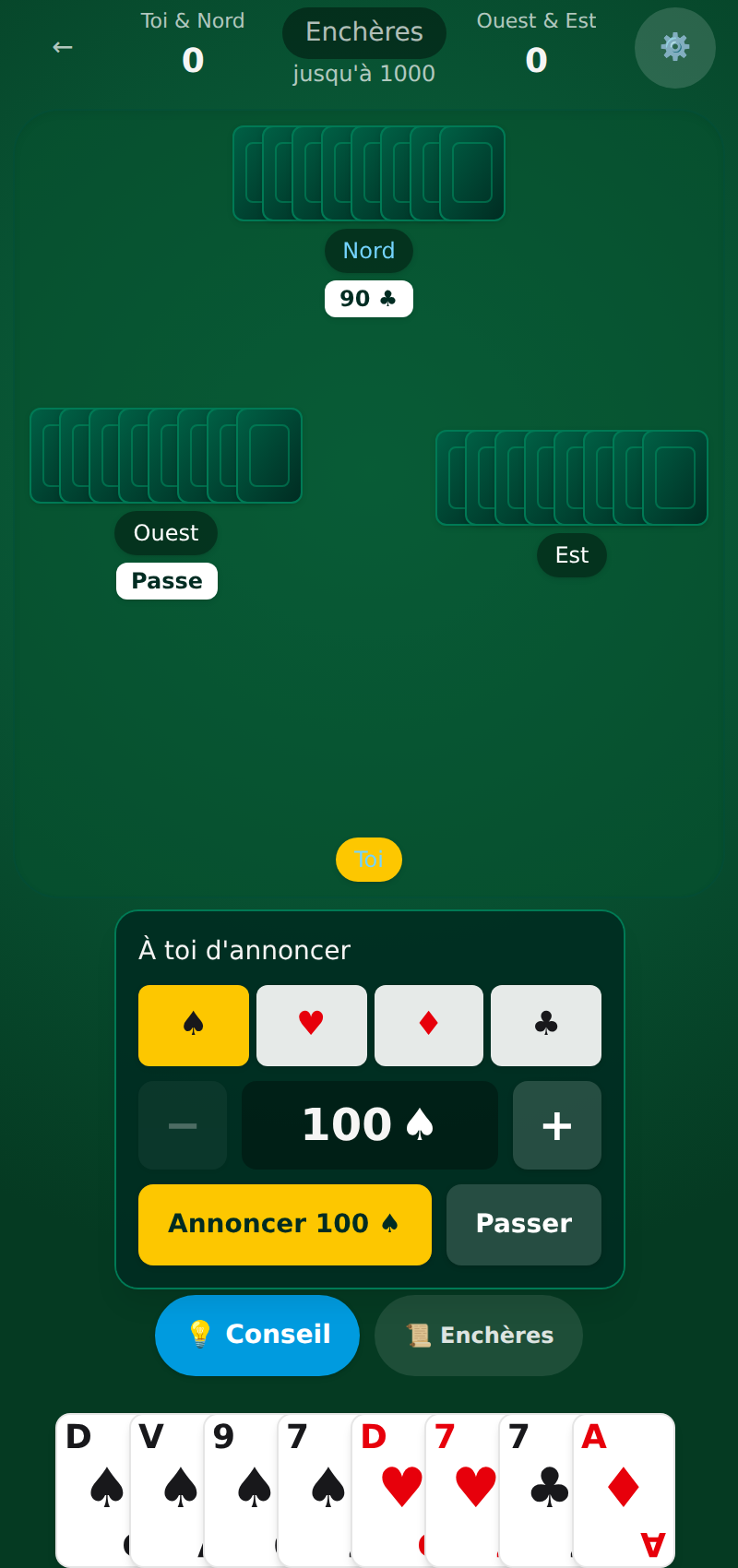 Want to practise? Play coinche online for free: tunable AIs and a coach are waiting for you on Coincheur.
See also
FAQ
Does coinche come from bridge?
Coinche is a belote with bidding and a doubling system inspired by bridge, hence its name. But it is a distinct, 32-card game.
Is bridge more complex than coinche?
Bridge has very developed bidding systems that take a long time to learn. Coinche stays more accessible while keeping a real strategic dimension.