Coinche vs bid belote
Updated
"Bid belote" (belote bridgee) and "coinche" describe very close games: belote with a bidding phase. The nuances are mostly about vocabulary and table conventions.
Two names, one idea
Bid belote is named that way because it borrows the bidding phase from bridge. Coinche (or contree) is also a bid belote. In common use, many players treat these terms as near-synonyms, or see coinche as a form of bid belote with the option to double.
The shared coinche core
Whatever the name, you find: 4 players in 2 teams, 32 cards, 8 tricks, trump chosen by bidding, and 162 points per deal (152 + 10 for the last trick). The belote (trump King + Queen) is worth 20.
| Coinche | Bid belote | |
|---|---|---|
| Base | bid belote | bid belote |
| Name origin | from "coincher" | borrowed from bridge |
| Doubling | yes (coinche/surcoinche) | by convention |
What bridge brings
What bid belote borrows from bridge is the idea of raising bids in steps and publicly committing to a numeric goal. This transforms belote: the deal is no longer just about playing your cards, it starts with a dialogue of calls where each team gauges its own hand and the opposition's. Coinche pushes this logic further with doubling, which adds a genuine standoff of confidence between the two teams.
What can vary
Differences mostly come down to local conventions: bidding steps, exact handling of doubling, whether surcoinche exists, how calls are scored. Before playing with a new group, it is wise to agree on these points, as with any variant. This flexibility explains why one game carries several names across regions.
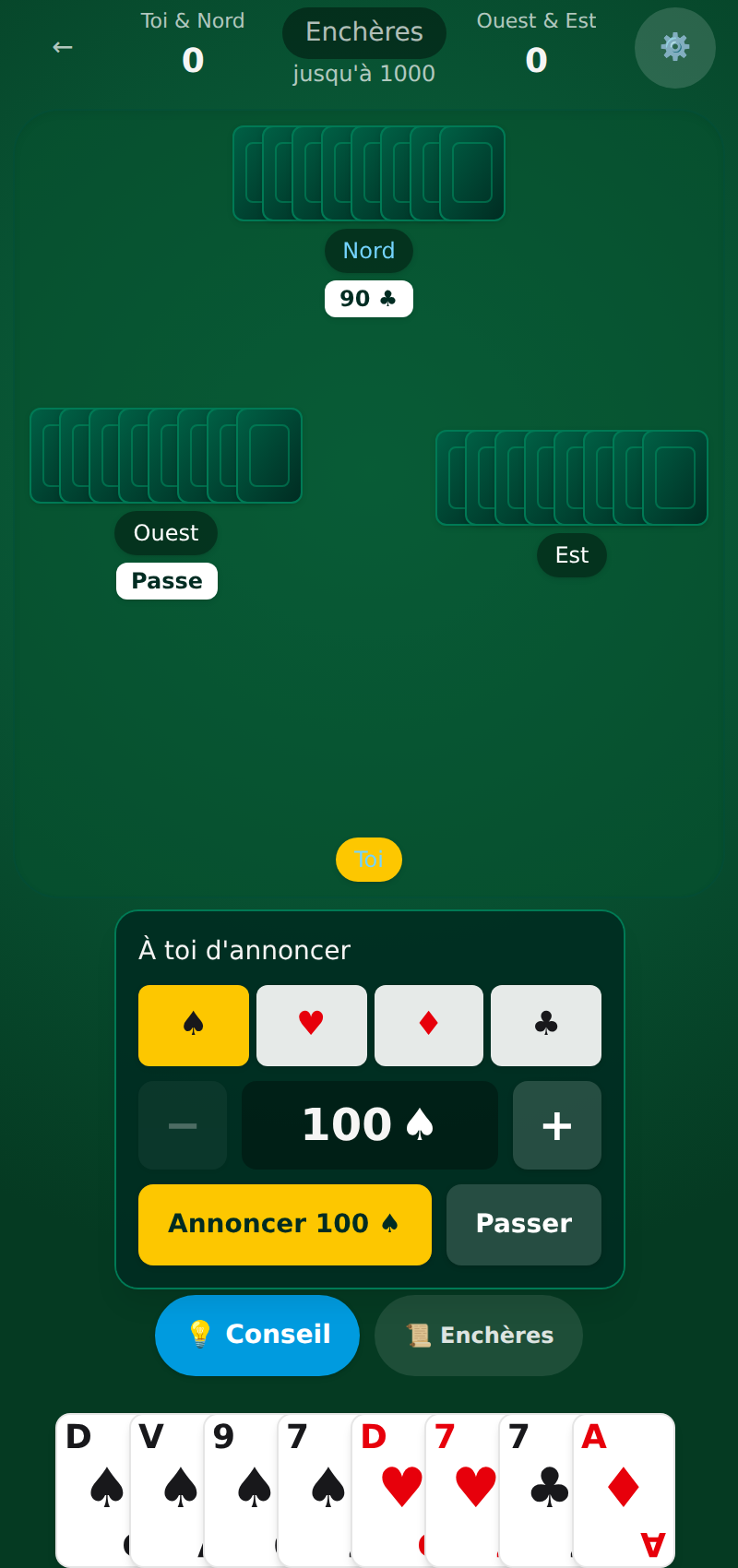 Want to practise? Play coinche online for free: tunable AIs and a coach are waiting for you on Coincheur.
See also
FAQ
Are bid belote and coinche the same?
They are very close games: both are belote with bidding. Depending on the region and the table, the terms overlap heavily.
Why is it called "bid" belote?
Because this variant borrows a bidding phase from bridge, added to the classic belote mechanics.