Midgame: reconstructing the hands
Updated
By the midgame, the first tricks have already told you about the opponents' hands. Reconstructing their cards transforms the end of the deal.
Start from the clues already given
The auction bids, the ruffs and the discards betray distributions. An opponent who ruffs a suit is void in it; a player who discards it is weak there. The contract bid also shows where strength is concentrated.
Count the suits
Like trumps, count how many cards of each suit have fallen. Each suit has 8 cards. If you've seen 6 and hold 2, the suit is exhausted: your remaining cards become sure masters or sure ruffers.
Adapt your endgame
- You know who will ruff: don't hand them a big trick.
- You know who holds the remaining master: don't challenge it for nothing.
- Place your points where your side is sure to win.
Example: rebuilding a hand by the 4th trick
You took 100 in spades with J♠ 9♠ 10♠ 8♠. In the bidding, your left-hand opponent had bid 80 in hearts. Four trumps are outside: A, K, Q and 7.
- Trick 1: you lead the jack. Your partner and your left-hand opponent follow, your right-hand opponent discards a club. Only 2 trumps remain outside (4 - 2), and they're not on your right.
- What you deduce: your right-hand opponent can no longer ruff. The 2 remaining trumps are with your partner or your left-hand opponent.
- With the heart bid: your left-hand opponent probably holds the ace or ten of hearts. Don't lead your king of hearts toward them without a reason.
- The club discard suggests your right-hand opponent is weak in that suit, or is signaling something there.
The common mistake: trusting a single clue
A discard can be real information, a signal to a partner, or even a bluff. A bid can rest on a weaker hand than expected. Before building your plan on a deduction, look for a second clue that confirms it: a card count, a card that should have appeared but didn't, a ruff. Guidelines:
- Ruffs are the most reliable clues: a player who ruffs is out of the suit.
- The bidding shows the trend, the tricks confirm it.
- Reassess on every trick: a hand is rebuilt a little at a time.
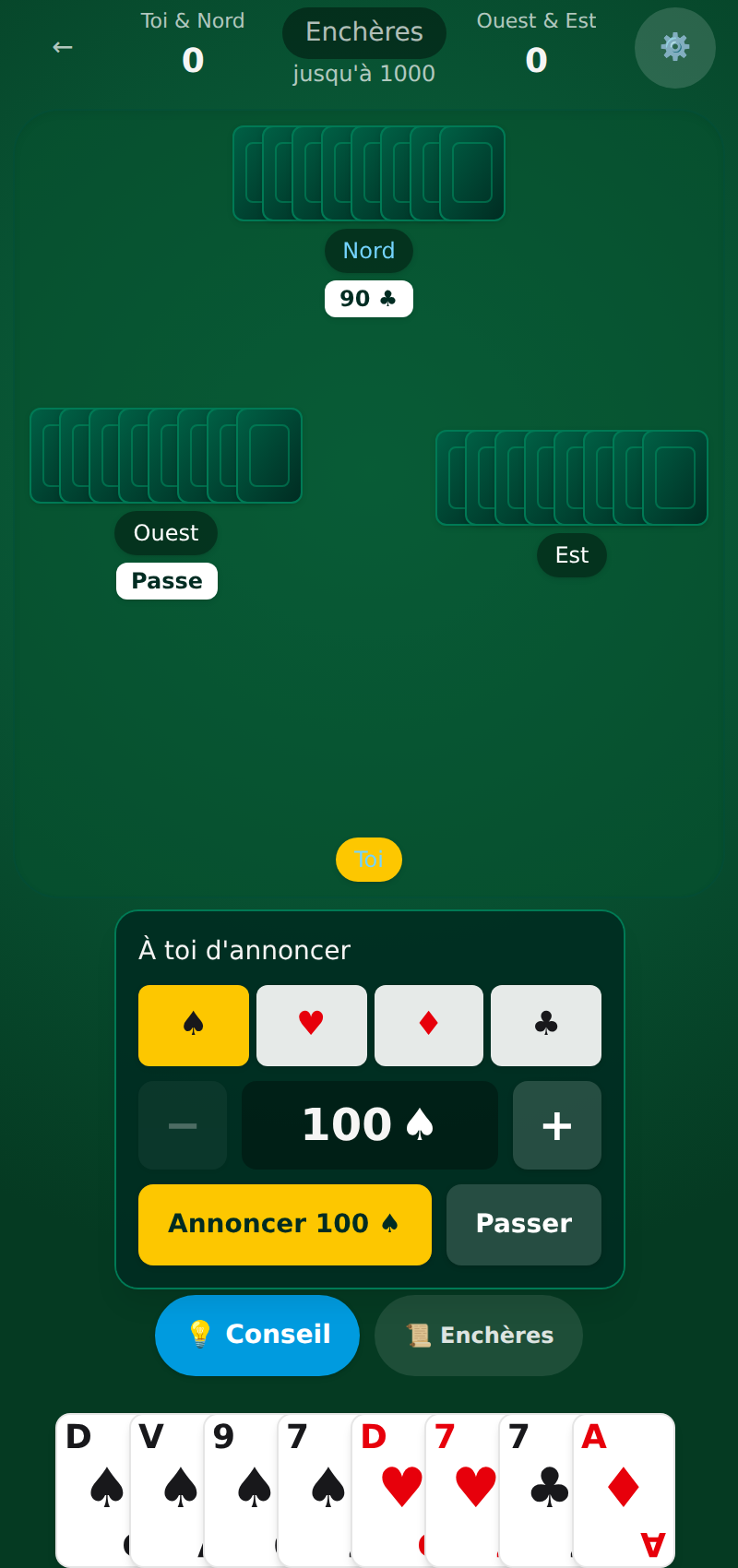 Want to practise? Play coinche online for free: tunable AIs and a coach are waiting for you on Coincheur.
See also
FAQ
How do you guess the opponents' cards in coinche?
By cross-checking bids, ruffs and discards, and counting the cards played in each suit. A suit that's ruffed or discarded reveals a weakness.
Do you have to count every suit?
Ideally yes: each suit has 8 cards. Following at least the trump suit and the contract's key suit already lets you read the endgame well.
When can you start rebuilding the hands?
From the bidding, which gives a first trend. After two or three tricks, ruffs and discards fill in the picture, and by the midgame you often have enough clues to play the ending precisely.