Coinche vs rummy
Updated
Coinche and rummy illustrate two great card-game logics: winning tricks on one side, forming melds on the other.
Two opposite goals
In coinche, you aim to win tricks worth points, as a team, with trump set by bidding. In rummy, you aim to form runs and sets by drawing and discarding, to lay down your melds and empty your hand. The two mechanics share almost nothing.
| Coinche | Rummy | |
|---|---|---|
| Goal | win tricks | form melds |
| Teams | yes (2v2) | usually solo |
| Trump | yes, by bidding | no |
| Players | 4 | 2 to 4 by variant |
Skills involved
Coinche calls on hand evaluation for bidding, memory of played cards and coordination with your partner throughout the deal. Rummy leans more on managing your own hand, reading the draw and discard piles, and choosing the best moment to lay down your runs and sets.
Luck and control
Rummy leaves room for the luck of the draw, which makes it accessible and unpredictable: a good draw can rescue a tough hand. Coinche, once the cards are dealt, depends only on the players' decisions: the bid, the choice of trump and the order in which you play your cards. This greater degree of control appeals to those who like to feel their choices make the difference rather than the luck of the pile.
Which mood?
Rummy is flexible in player count and relaxed, perfect for chatting while you play. Coinche needs exactly four players and offers the tension of betting, doubling and team coordination. Both are excellent games for different moments: rummy to unwind, coinche for a strategic four-player challenge.
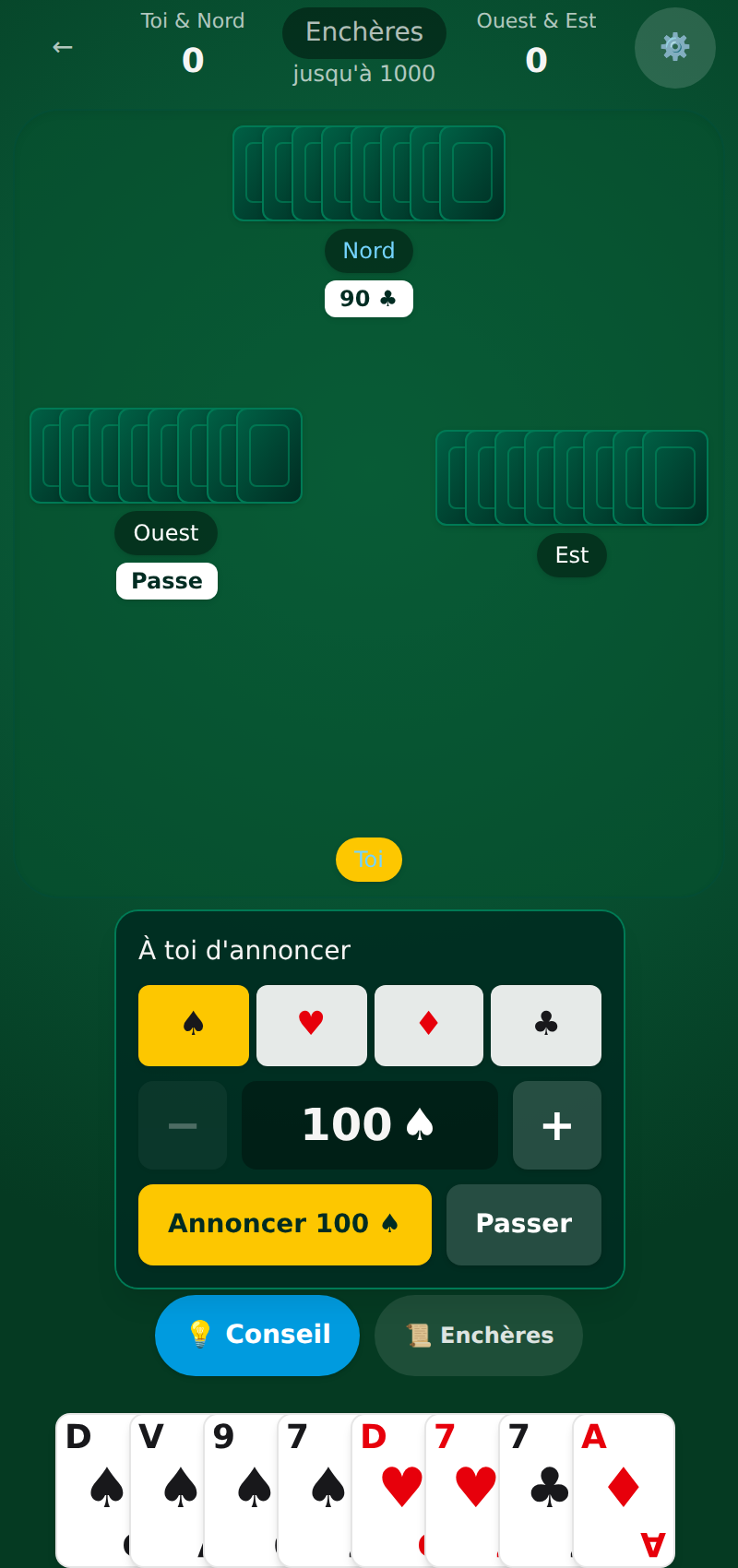 Want to practise? Play coinche online for free: tunable AIs and a coach are waiting for you on Coincheur.
See also
FAQ
Are rummy and coinche played the same way?
No. Coinche is a team trick game with trump and bidding; rummy is a melding game where you form runs and sets.
Is rummy also played in teams?
Rummy is most often played solo, with 2 to 4 players, while coinche pits two fixed teams of two.