Printable coinche cheat sheet: the rules on one page
Updated
Here is a complete, compact summary of the rules of coinche, made to be printed and kept by the table for your first games. Use Ctrl/Cmd+P to print it or save it as a PDF.
Setup
Coinche is played by 4 players in 2 teams (partners sit opposite), with a 32-card deck. Each player gets 8 cards, usually dealt in packets of 3, then 2, then 3. Play traditionally goes counter-clockwise: the player to the dealer's right bids first, and the next dealer is the player to the previous one's right. Some tables play the other way round: agree on it before the game.
The bidding
In turn, each player either announces a contract (a points target and a trump suit) or passes. Bids run from 80 up to capot, in steps of 10. If an opponent thinks the contract will fail, they coinche (double, ×2); the declaring side may surcoinche (redouble, ×4). See the full coinche rules.
Playing the hand
The player to the dealer's right leads. Everyone must follow suit if able. At trumps, you must overruff when ruffing after a partner already beaten by an opponent. The trick goes to the highest card (a trump if any was played). The trick winner leads next.
Card values and the trump reflex
| Card | Trump | Side suit |
|---|---|---|
| Jack | 20 | 2 |
| 9 | 14 | 0 |
| Ace | 11 | 11 |
| 10 | 10 | 10 |
| King | 4 | 4 |
| Queen | 3 | 3 |
| 8 and 7 | 0 | 0 |
In trump, the Jack then the 9 rule, not the Ace. In side suits, the classic order returns: Ace, 10, King, Queen, Jack. Memorise this flip: it's the source of many surprises for beginners who think their Ace is unbeatable. No-trump and all-trump values are in the card values table.
Scoring
A deal is worth 162 points (152 in the cards + the 10 de der for the last trick). A belote (King + Queen of trumps in one hand) adds 20 points. The contract is made if the declaring side reaches its bid; otherwise it fails and the points go to the defence. See counting points.
| Item | Points |
|---|---|
| Total of one deal | 162 |
| Belote (K+Q of trumps) | +20 |
| Capot (every trick, unbid) | 252 (162 + 90) |
| Bid capot (250 contract) made | 252 + 250 = 502 |
| Coinche / surcoinche | contract ×2 / ×4 |
Keep this cheat sheet
To save this sheet, open the print dialog with Ctrl+P (Windows/Linux) or Cmd+P (Mac), then pick your printer or choose "Save as PDF." Keep it by the table for your first games: as the deals go by, you won't need to look at it any more.
To remember the numbers, tie each one to an image: 162 is "the full deal", the 20 of belote is "the King-Queen couple", the 250 of a bid capot is "all or nothing". And nothing beats practice: play a game against the AI, and the automatic scoring anchors the values trick after trick. Some conventions (belote, unbid capot) vary by table, so agree on them with your partners before you start.
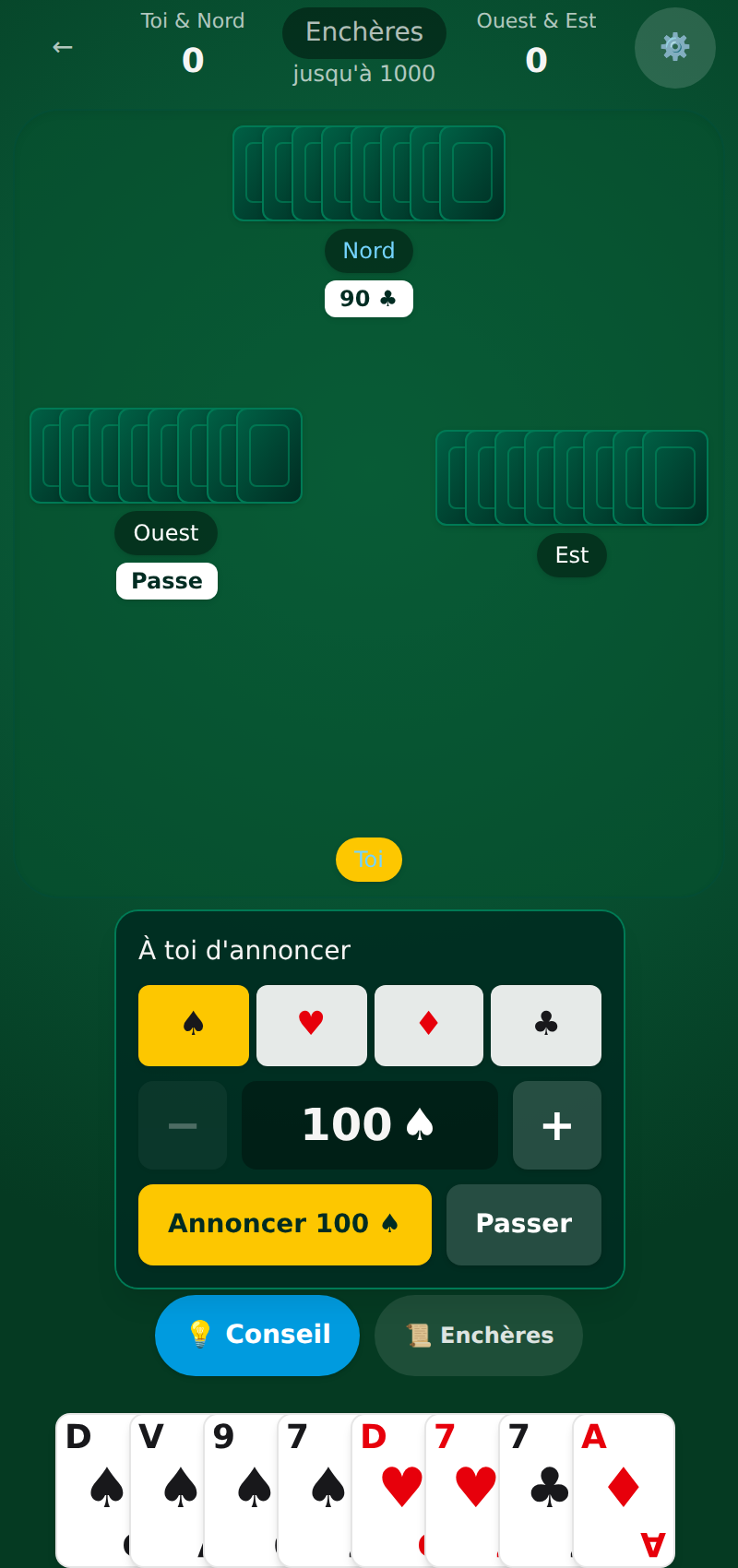 Want to practise? Play coinche online for free: tunable AIs and a coach are waiting for you on Coincheur.
See also
FAQ
How do I print or save these rules as a PDF?
Open the print dialog with Ctrl+P (Windows/Linux) or Cmd+P (Mac), then choose your printer or the "Save as PDF" option.
How many points is a deal worth?
A deal is worth 162 points: 152 in the cards plus 10 de der for the last trick. A belote adds 20 points.
What does coinche mean?
To coinche is to declare that you think the opponents' contract will fail. The contract value is then doubled (×2), and the declaring side can redouble (surcoinche, ×4).
What is the strongest trump card?
The trump Jack: it's worth 20 points and beats every other card, including the trump Ace. The trump 9 (14 points) comes right behind.
What's the best way to learn the rules?
Play a few deals against the AI with this sheet beside you: you see the flow in action and the automatic scoring helps you absorb card values by example.