Calculate a coinche contract's score
Updated
Made or failed? The maths changes completely. Here's the rule, with clear worked examples.
Contract made
The taker succeeds if they reach their bid with the points scored (cards + last-trick bonus, belote included). The taking team then scores the contract value (often the bid, sometimes more depending on points made) and the defence scores its own points. Example: a 110 contract, taker makes 118 -> made, the taking team scores per the table's scale.
Contract failed (inside)
If the taker falls short of the bid, the contract fails (it's “inside,” dedans). The defence wins the stake: most often 162 + the contract amount, and the taker scores 0. Example: a 120 contract, taker makes only 100 -> failed, the defence scores 162 + 120 = 282, the taker 0.
Coinche and surcoinche
| Situation | Multiplier |
|---|---|
| Normal contract | x1 |
| Coinched | x2 |
| Surcoinched | x4 |
A coinche doubles the contract's value, a surcoinche quadruples it: the winner scores 162 + contract × 2 (or × 4). Making a coinched contract pays big; failing it costs dearly. On Coincheur this is applied automatically each deal.
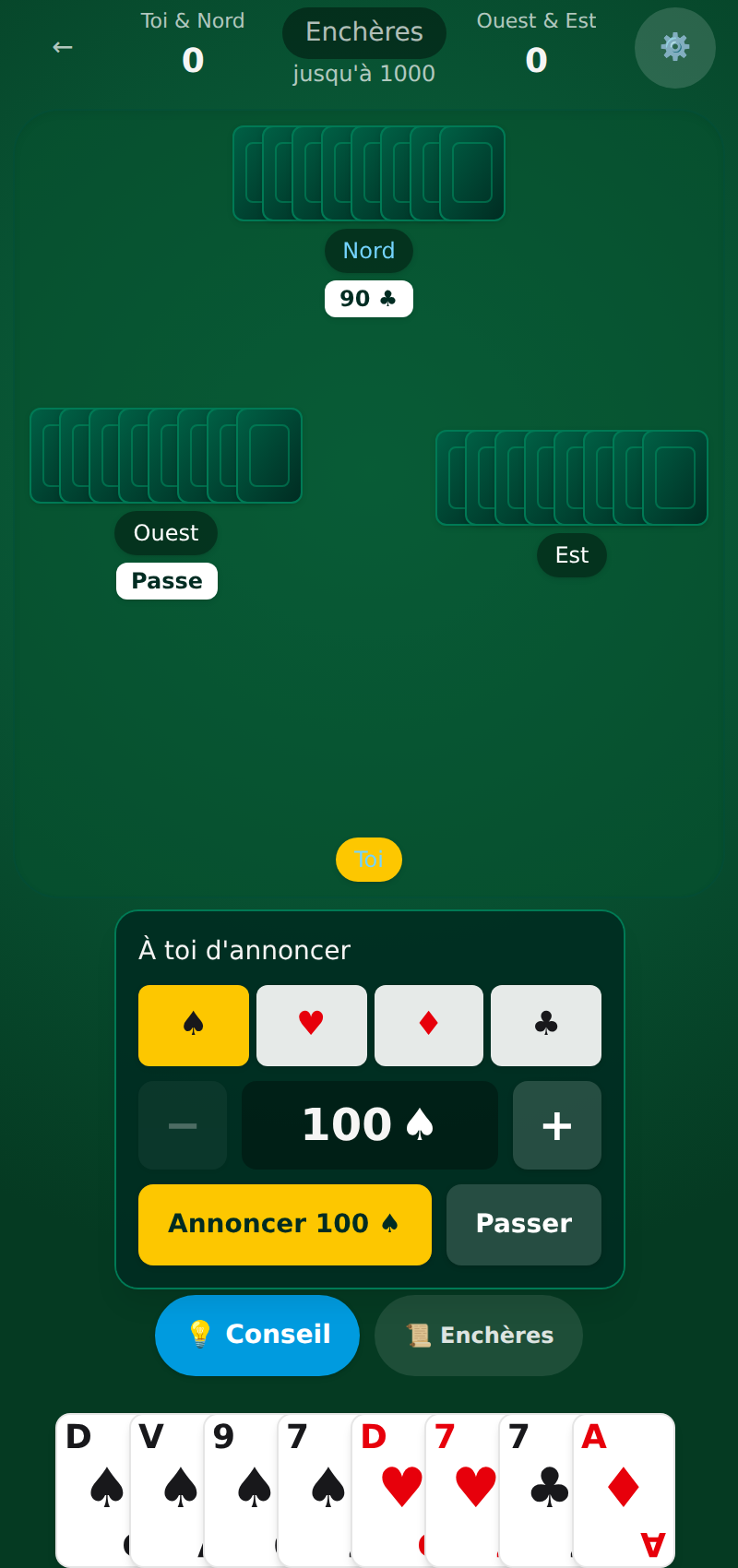 Want to practise? Play coinche online for free: tunable AIs and a coach are waiting for you on Coincheur.
See also
FAQ
How do you know if a contract is made?
The taker succeeds by reaching at least their bid with the points scored (cards, last-trick bonus and belote included). Otherwise the contract fails.
What does the defence score if the contract fails?
Most often 162 (the deal's points) plus the announced contract amount, while the taker scores 0. The exact scale can vary by table.
What does a coinche change?
A coinche doubles (x2) the contract's value, a surcoinche quadruples it (x4): the winner scores 162 plus the multiplied contract. Making it then pays far more, but failing costs all the more.