Bridged contrée
Updated
Bridged contrée is a variant where bidding borrows from bridge: more descriptive, more codified, to better describe your hand to your partner.
The starting idea
In classic coinche, the bid mainly states how many points you commit to and in which trump. Bridged contrée pushes the communication dimension further: bids describe the strength and shape of your hand, as in bridge, to help your partner bid accurately.
What changes
- Richer bidding: some bids carry a conventional meaning (showing a long suit, overall strength, etc.).
- Codified escalation: contract progression follows a logic close to bridge steps.
- Doubling keeps its role: you can still coinche an opponent's contract judged too optimistic.
Who is it for?
It's a variant for experienced players, often played by people who already know bridge. It needs clear conventions shared by both partners. Beware: there's no single system, every circle has its own codes. Settle them precisely before playing, or risk costly misunderstandings.
Example sequence (one possible agreement, not an official system)
To give you an idea, here's the kind of agreement a partnership might make. It's only an illustration: every group has its own codes.
- South opens “80 hearts”: under this agreement, it promises the Jack of hearts and a reasonable hand, not necessarily much more.
- North replies “90 hearts”: here, each 10-point step above partner's bid shows a side Ace. So North is saying “I have an Ace.”
- North could have bid “90 spades” instead: under this agreement, switching suit shows a long, solid suit and invites South to choose.
After two or three rounds, each player knows the other's strengths far better than with bidding by feel. That's the whole appeal of the variant, and also its weak spot: if one partner forgets the agreement, the auction tells a false story.
Pros and cons
| Pros | Cons |
|---|---|
| More precise bidding, better-judged contracts | Takes work and memory |
| Fewer nasty surprise coinches | Opponents can read your bids too |
| The fun of building a real shared language | Confusing for a guest player |
Card play and scoring usually stay the same as in coinche: 162 points per deal, belote 20, bid capot at 250. Only the bidding changes. If you want to try it, start with a handful of simple agreements, write them down, and add more as you go. The basics of communicating through the auction are covered in supporting your partner's bid.
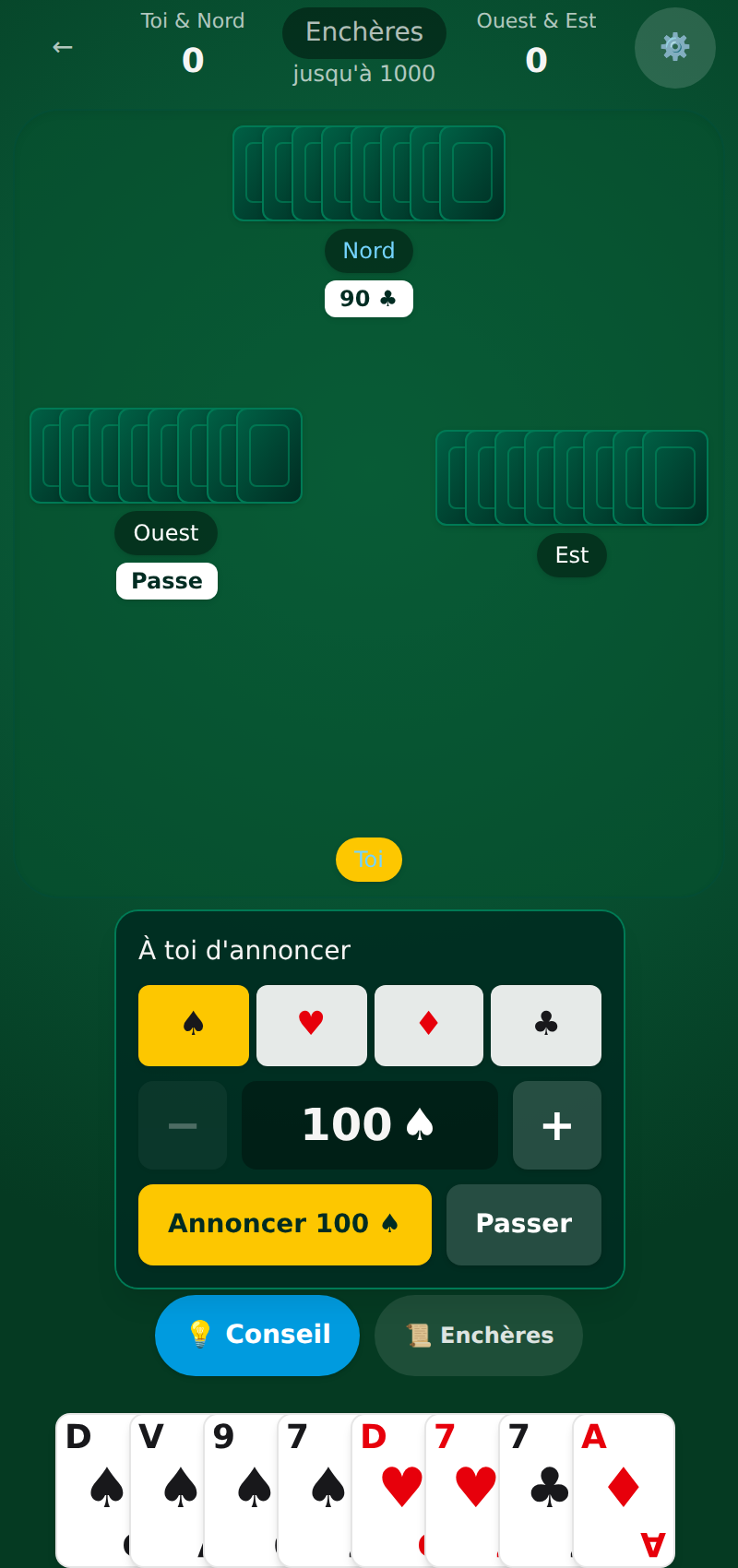 Want to practise? Play coinche online for free: tunable AIs and a coach are waiting for you on Coincheur.
See also
FAQ
What is bridged contrée?
It's a coinche variant whose bidding borrows from bridge: more descriptive and codified, it serves to describe your hand to your partner rather than just announcing a number of points.
Do you need to know bridge to play it?
It's not mandatory, but it helps a lot. The variant needs clear, shared bidding conventions. Since there's no single system, agree on the codes before playing.
Does the scoring change in bridged contrée?
Usually not: you keep 162 points per deal, belote at 20 and bid capot at 250. It's how you bid that changes, not the scale. Still, check your table's customs.
Should you explain your agreements to the opponents?
That's the sporting approach, as in bridge: opponents are entitled to know what your bids mean. What's forbidden is hidden signals outside the bidding itself.