Coinche with two players
Updated
Coinche is a four-player game (two pairs). With two players there is no official rule set: any adaptation changes the game deeply.
Why it isn't "real coinche"
The appeal of coinche is the partnership: bidding, signals, reading your partner. With two players all of that vanishes. So-called "2-player coinche" is really a derived trick-taking game, best seen as a stopgap convention rather than a recognised variant.
Most common adaptations
- Draw pile: each player gets a few cards, the rest forms a stock you draw from after each trick (like two-player belote).
- Reduced deck: remove low cards (for example the 7s and 8s) to keep a manageable pack.
- Simplified bidding: a single bidding round, with no real escalation since there's no partner to inform.
Agree on all of this before you play: none of it is universal.
Does the scoring stay the same?
If you keep the usual 32 cards, you can keep the standard scoring (162 points per deal, belote 20, bid capot at 250). If you remove cards, the per-deal total shifts automatically: recount the value of the remaining cards to set a sensible target.
Our advice
With two players you're often better off playing classic two-handed belote, which has well-established two-player rules, rather than forcing coinche. Save coinche for four-player evenings, where it truly shines.
What about 2 players online?
Online, the missing-fourth problem disappears. On Coincheur, you create a private room, send the link to your friend, and the AI takes the two remaining seats. Your friend is automatically seated across from you: you play together, two of you against two AIs, with the real four-player coinche rules. It's all explained in play coinche with friends online.
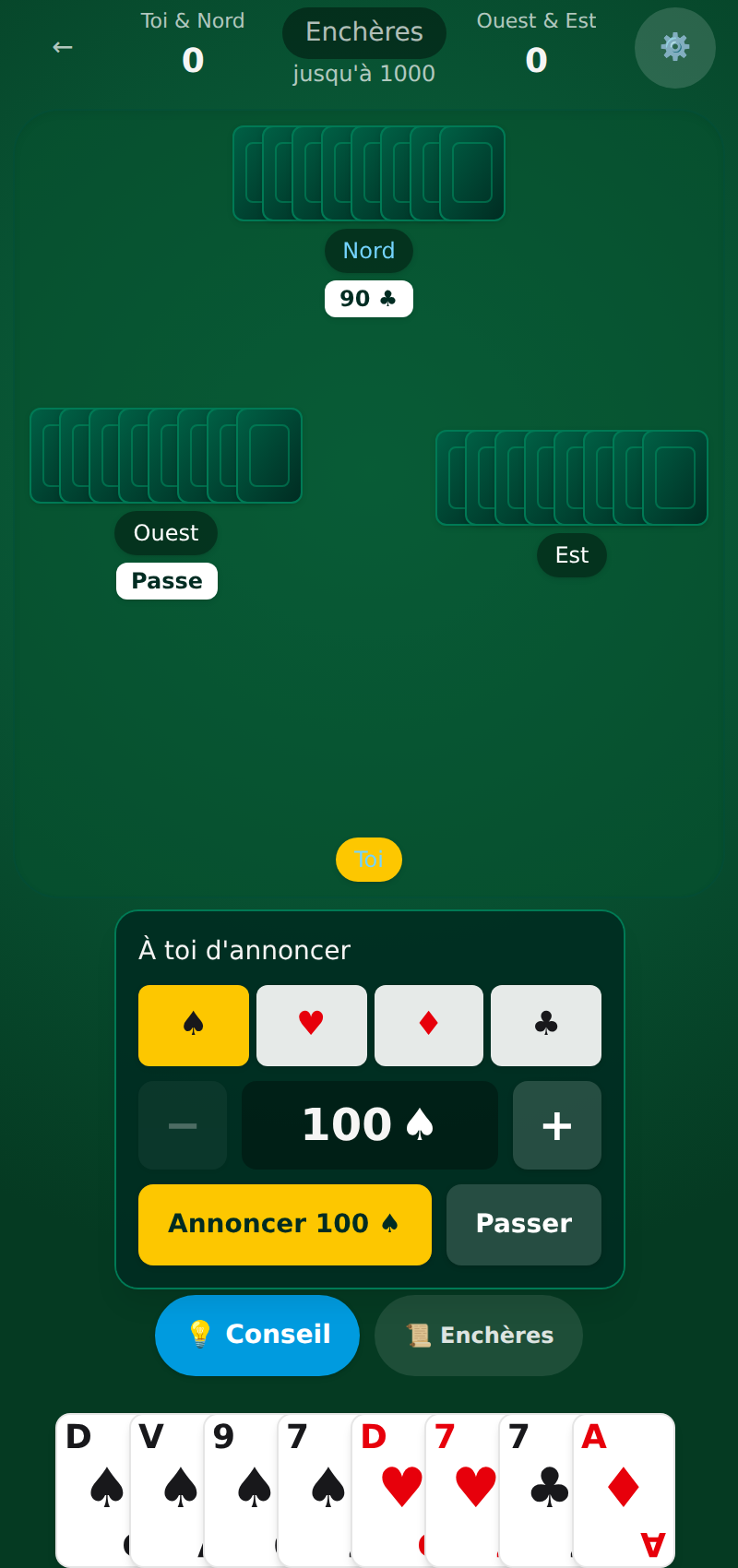 Want to practise? Play coinche online for free: tunable AIs and a coach are waiting for you on Coincheur.
See also
FAQ
Can you really play coinche with 2 players?
You can adapt it, but it isn't an official format. Coinche relies on partnership, which disappears with two players. Two-player rules are conventions to agree on before playing.
Do you remove cards with 2 players?
It's a common option to keep a manageable pack, for example removing the 7s and 8s. If you do, recount the value of the remaining cards because the per-deal total changes.